For generations, the backbone of small-scale poultry farming has been the wooden coop. It’s a familiar sight: a simple structure offering shelter, a place to roost, and a modicum of security. But as we move further into 2024, the expectations for what a wooden coop can and should be have evolved dramatically. The modern poultry farmer, whether managing a backyard flock of fifty or a free-range enterprise of several hundred, is no longer looking for just a box with a door. They are investing in a complete environment—a system designed to promote animal welfare, streamline daily chores, and integrate seamlessly into a sustainable farming operation. The latest designs in large wooden chicken coops reflect this shift, moving from basic shelters to sophisticated husbandry tools.
The most significant advancement in 2024 coop design is the move away from a single, monolithic structure towards a modular, multi-space concept. Instead of one large shed, think of it as a central hub connected to specialized zones. The hub is the core shelter, the place for roosting bars and nesting boxes. Attached to this is a dedicated, fully enclosed run, and beyond that, a system for controlled access to pasture. This tripartite design—shelter, secure run, and free-range corridor—directly addresses the three core needs of a laying hen or broiler: security for nighttime, activity space for daytime, and access to a natural diet.
The Core Shelter: Engineered for Health and Efficiency
The heart of the system remains the main coop. While the material—typically sustainably sourced, kiln-dried pine or cedar—is classic, the engineering is thoroughly modern. The primary goal is to create a dry, draft-free, yet well-ventilated environment. This is achieved not by sealing the coop tightly, but by strategically placing ventilation.
Older designs might have relied on a few small windows. The 2024 approach uses continuous ridge ventilation along the peak of the roof. As warm, moisture-laden air from the birds’ respiration and manure rises, it escapes through this high opening, creating a passive airflow that draws fresh air in through lower, adjustable vents on the leeward side of the coop. A farmer in a humid climate will keep these lower vents open wider during winter to manage moisture without creating a ground-level draft that can chill birds. In a colder, drier region, the vents might be cracked just enough to allow for minimal moisture buildup. This constant air exchange is the single most important factor in preventing respiratory issues; it’s the difference between a coop that smells musty and damp by morning and one that feels fresh.
Inside, the layout is meticulously planned for labor efficiency. Roosting bars are positioned at a uniform height, but crucially, they are designed to be easily removable. A farmer can slide the entire set of bars out for a quick scrape and disinfect, rather than trying to maneuver a brush in a cramped space. The placement of these bars is also calculated to prevent birds from roosting above one another, which leads to manure-soiled feathers and potential health problems.
Nesting boxes have seen perhaps the most user-friendly innovations. The standard design now includes an external access hatch. This means that for the daily task of egg collection, there is no need to enter the coop itself. A farmer simply walks along the outside of the structure, unlatches a series of small, weatherproof doors, and collects the eggs from the outside. This not only saves time but also minimizes disturbance to the flock. Furthermore, the flooring of these nesting boxes is often sloped slightly forward. When a hen leaves the box, any eggs roll gently to the front, landing on a soft cushioning material, which significantly reduces the incidence of hairline cracks and breakages.
Predator-proofing has moved from an afterthought to a foundational design principle. It’s no longer just about a strong lock on the door. It involves hardware cloth—a sturdy, welded wire mesh—buried at least a foot deep around the entire perimeter of the coop and run to deter digging animals like foxes and raccoons. All openings, including ventilation points, are covered with this same mesh. Latches are no longer simple hooks and eyes; they are now typically sliding-bolt locks or even carabiner-style clips that require a level of dexterity far beyond what a raccoon’s paws can manage. This comprehensive approach treats security as a system-wide requirement, not a feature.
The Enclosed Run: The Active Aviary
Adjacent to the core shelter is the enclosed run. This space is the birds’ daytime world when they are not on pasture. Its design focuses on promoting natural behaviors, which is directly linked to flock health and product quality. The roof of this run is just as important as the roof of the coop itself. A solid, waterproof roof over at least a portion of the run provides a dry area for the birds to dust bathe and forage, even during rain. This prevents the run from turning into a muddy, unsanitary quagmire.
Within the run, the environment is enriched. This is where technical terms like “environmental enrichment” become practical. It means hanging bundles of greens like kale or lettuce for the birds to peck at, which reduces feather pecking among flock mates. It means providing sturdy branches or purpose-built platforms at different heights, encouraging flying and perching, which strengthens their skeletal systems. A farmer might scatter their grain ration throughout the run’s wood shavings or straw bedding, forcing the chickens to scratch and search as they would in the wild. This constant activity results in stronger, healthier birds and, for layers, eggs with richer, more vibrant yolks due to the increased muscle development and diverse diet.
The run also incorporates critical management features. A pop hole—the doorway between the coop and the run—is equipped with an automatic door opener. This simple device, powered by a small solar panel or battery, opens the door at sunrise and closes it at dusk. This eliminates the farmer’s need to be present at specific times every single day, providing a remarkable degree of flexibility and ensuring the flock’s safety is never compromised by a forgotten chore.
The Free-Range Connection: Managed Grazing
For operations marketing free-range or pasture-raised poultry, the coop system must facilitate easy and safe access to open land. The 2024 designs achieve this through the use of a “chunnel” (chicken tunnel) or a series of lightweight, portable range pens. The chunnel is a secure, mesh-covered corridor that connects the main enclosed run to a fresh section of pasture. Every few days, the exit point of the chunnel is moved to a new “paddock,” giving the birds access to new forage while allowing the previously grazed area to recover.
This rotational grazing is a core principle of regenerative agriculture. From a practical standpoint, it means the birds are constantly consuming a diverse mix of grasses, clover, insects, and seeds. This not only reduces feed costs but also improves the nutritional profile of the meat and eggs. The birds’ manure is distributed across the pasture, acting as a natural fertilizer, rather than being concentrated in one spot where it can become a pollutant. The constant movement also breaks the life cycle of parasites and pathogens, reducing the need for medical interventions.
For larger flocks, the entire coop structure itself may be designed to be mobile. These “chicken tractors” are large, floorless wooden coops on skids or wheels that are dragged or towed across a field daily. This is the ultimate expression of the free-range system, ensuring the birds always have fresh ground beneath their feet. The design challenges here involve creating a structure that is both light enough to move regularly yet robust enough to withstand the elements and protect against predators.
Material and Construction Considerations for Longevity
The choice of wood remains popular for its natural insulation properties, breathability, and aesthetic appeal. However, 2024 designs specify woods like cedar or redwood for their natural resistance to rot and insects, or use pressure-treated lumber for the skids and floor joists that contact the ground, with the clear stipulation that any treated wood must be safe for animal contact. The construction methods have also improved. Tongue-and-groove siding is often used instead of simple lap siding, as it creates a tighter seal against wind and driving rain. Roofs are typically metal for its longevity and slick surface, which discourages wild birds from roosting and potentially introducing disease.

A key feature for maintenance is the inclusion of large, human-sized doors. This allows the farmer to walk inside for a complete clean-out. Some designs even feature a fully removable roof or large side panels that swing open, enabling easy access with a small tractor or cart for deep litter management. In a deep litter system, carbon-rich bedding like wood shavings is added regularly, and the manure composts in place, generating heat in the winter. At the end of the season, the farmer removes this material, which has become a valuable, nutrient-rich compost for gardens or fields.
Selecting the Right System for Your Flock
Choosing a 2024 wooden coop system is not about finding the largest one for sale; it’s about matching the design to the specific needs of the farm. A backyard enthusiast with a small flock of heritage breeds will prioritize aesthetics and ease of cleaning. A commercial free-range egg producer will focus on modularity, egg collection efficiency, and the robustness of the rotational grazing components. A meat bird operation will look for designs that facilitate easy movement of birds and integration with processing facilities.
The initial investment in a well-designed, large wooden coop system is significant. But it is an investment in the future of the flock. It pays dividends in reduced veterinary bills through better health, decreased labor time through smart automation, improved product quality through enhanced welfare, and the long-term sustainability of the land through managed grazing practices. The modern wooden coop is no longer just a house for chickens; it is the central component of a holistic, profitable, and ethical poultry farming operation.
1. Drinking system include the water pipes, water pressure adjuster, drinking nipples, Waterline front-end device, dosing system etc, choose them according to customer's needs.
2. High-quality water drinking pipes, pressure regulating valves and water drinking nipples can effectively prevent the water leakage. Drinking system adopt the closed piping system, which can minimize the water pollution.
3. 360-degree drinking nipples provide adequate drinking water for poultry at all stages.
4. The automatic drinking water system mainly adopts the steel ball drinking nipple. lt uses imported high-grad stainless steel, POM resin, and APS engineering material, which is wearing resistant, and the durability can be used for long time.



1. Automatic feeding machine can be chosen between gantry and ladder feeding machine. Gantry type feeding machine is a relatively economical and practical machine with simple operation, remote control walking character, easy to manage.
2. Mechanical transmission device running smoothly, low noise, long service life.
3. With the use of automatic control, the feeding system can adjust the amount of material.
4. Feeding with arched structure, high carrying capacity, not easily deformed.
5. Saving man power, saving feed, greatly improving the efficiency of Large-scale farming.
6. The walking speed of gantry feeding machine is 9--12 m/min.




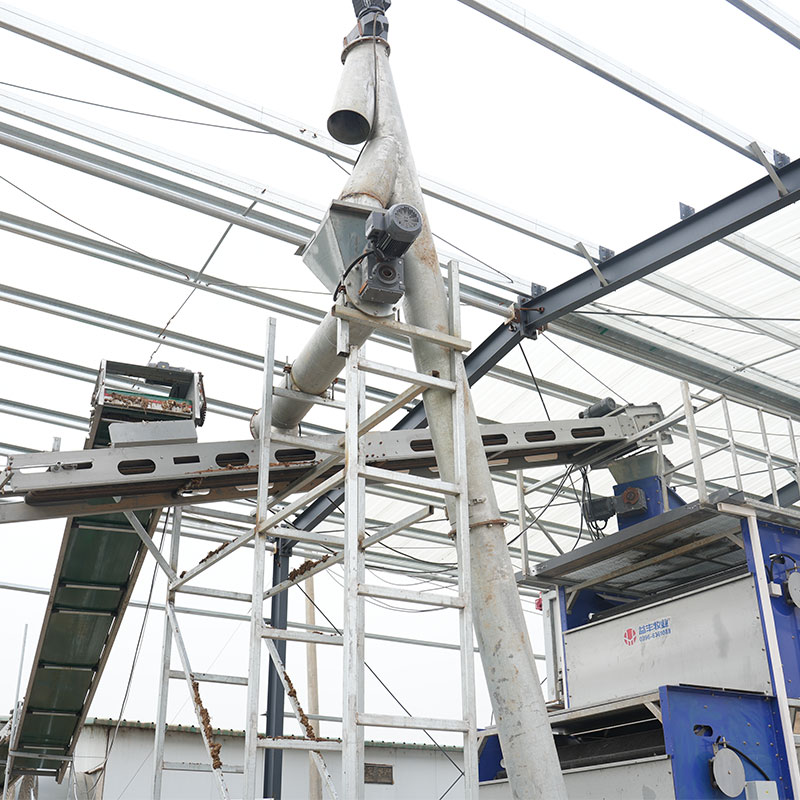
1. Manure removing system included scraper type and conveyor belt type, Which can reduce the labor intensity and labor cost, keep the chicken shed dry and clean.
2. A type chicken cage can use scraper type or conveyor belt type.


3. The scraper type is suitable for A type cages, which can clean two or three rows. For the starters, this type is a good choice. lt can not only save some labor cost, but also save some investment in the whole project. The cleaning speed is 6-10 meters per minute.
4. Conveyor belt type is more suitable for large scale farming. The manure removing belt we use is high quality PP material (polypropylene). The walking speed is 2-4 meters per minute.



High Quality Pellets Made by Mobile Pellet Machine
1. It has professional designed angle of the blade. After the dynamic balance test one by one, the blade can operate smoothly.
2. The air volume is consistent in the whole life of the fan. Bearings has advantage of high strength, low noise, durable and so on.
1. The cooling pads uses high-quality wet curtain paper and adopts space cross-linking technology, which has the advantages of high water absorption, high water resistance, anti-toxicity and long service life.
2. The cooling efficiency is over 80%, without surfactant, natural water absorption, fast diffusion speed and long-lasting effect.
3. The product does not contain phenol and other chemical substances that are easy to cause skin allergies. It is non-toxic and harmless to the human body and chicken when installed and used. It is green, safe, energy-saving, environmentally friendly, economical, and easy to install.
4. The frame aluminum alloy has high strength, good corrosion resistance, durability and beautiful appearance.
5. Use a special filter for the cooling pad at the upper water to ensure clean water quality and support efficient water circulation components.
6. Combined with a negative pressure fan, it can effectively lower the indoor temperature.
The window is made of special selected high-quality engineering plastic, with high strength and long service life, together with superior anti-aging and anti-UV performance.
Function: Ventilation of the chicken house, usually used in the winter.
This system can adjust the wind speed and direction, thus the cold air will not reach chicken directly , which can effectively prevent the phenomenon of cold stress in chicken.
Environmental control system equipment is suitable for large-scale and intensive farming. According to customer requirements, we can provide various types of smart poultry equipment.
1. Our poultry management system is a modular system that manages all aspects of the chicken house, such as climate, temperature, humidity, ammonia, feeding, feed weighing, lighting and ventilation systems, and can monitor the situation of the chicken house in real time through a computer and mobile phone.
2. The management computer is the heart of the poultry farm, allowing you to easily monitor the entire poultry farm.

 WeChat:+8617838608255