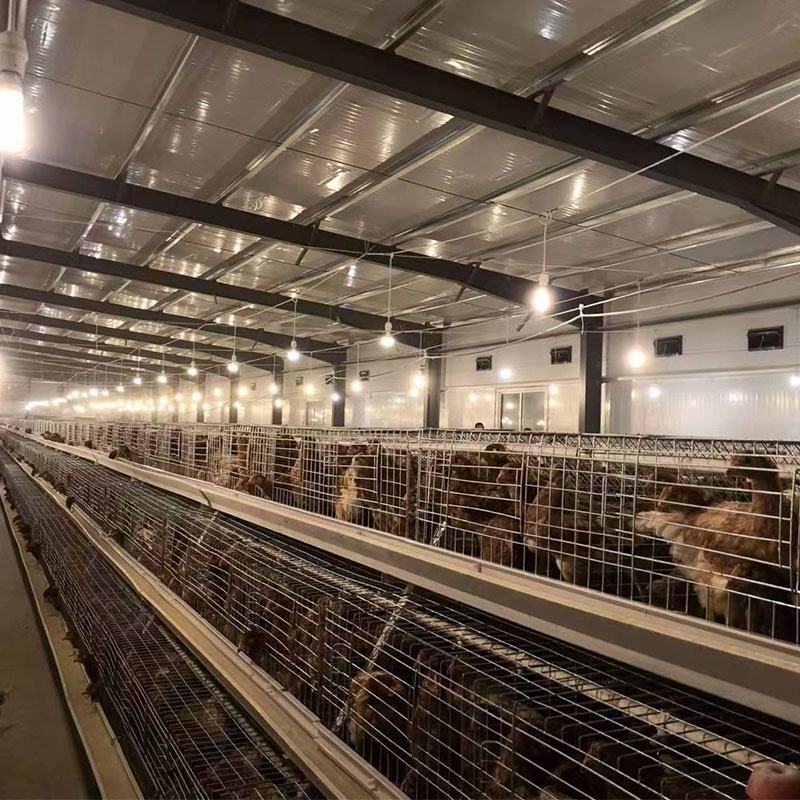
The morning feed run tells the story long before the balance sheets do. For the poultry farmer pushing a cart down a narrow aisle, the difference is in the details: the way birds rise uniformly to the feeder instead of scrambling over one another, the clean water nipples free of litter, the eggs that roll smoothly away from the cage onto the collection belt. This isn’t just a different housing arrangement; it’s a fundamental shift in the rhythm and economics of broiler production. The A-Type broiler cage system represents this shift, moving the industry from sprawling floor space toward controlled, vertical efficiency.


Understanding the “A-Type” designation requires a glance toward the roof. The cages are stacked in rows, and when viewed from the end of the aisle, the profile of the tiered structure forms the shape of a capital letter ‘A’. This isn’t an arbitrary design choice. The sloping floors are integral to the system's function. In a flat-floor housing scenario, manure accumulates across the entire litter area, creating a constant challenge with moisture, ammonia, and pathogen load. The A-Type cage turns this model on its head, quite literally.
Each cage level is equipped with a floor made of welded wire, sloped at a precise angle, typically between 7 and 10 degrees. When a bird defecates, the manure doesn’t stay put. It falls through the wire mesh onto a dedicated manure belt running beneath each tier or, in some designs, drops to a deep pit below the entire structure. This immediate separation of bird from waste is the single most impactful feature. It eliminates the birds’ contact with their own excrement, drastically cutting down on the parasite load and the incidence of diseases like coccidiosis, which thrive in damp litter. The air in the house smells different—sharper, yes, from the concentrated ammonia below, but without the overwhelming, damp, and musty odor of a floor-based operation. This cleaner environment translates directly to bird health. Farmers notice it in reduced medication costs and improved feed conversion ratios, as birds expend less energy fighting off subclinical illnesses and more on growth.
The design also dictates a new approach to feeding and watering. Nipple drinker lines run the length of each cage row, providing constant access to fresh water. Because the water system is enclosed and elevated, it remains free from contamination by litter, feathers, and feces, a common issue in floor systems that leads to biofilm buildup and disease spread. The feed trough, often located at the front of the cage, is equally protected. The birds eat from a consistent and clean source, reducing feed wastage from spillage or soiling. In a floor system, it’s common to see a halo of wasted feed around feeders, trampled into the damp litter. That waste is virtually eliminated in a cage system. Every kilogram of feed is accounted for and directed toward meat production, a critical factor when feed constitutes over 70% of the cost of production.
Density is a term that often sparks debate, but in practical terms, for the farmer, it’s about optimization of space and capital investment. A-Type cages allow for a higher stocking density per square meter of building footprint because they utilize the vertical space that would otherwise be empty air. A single-story building housing birds on the floor might hold 20 birds per square meter. That same building, fitted with a three-tier A-Type system, could effectively house 60 birds per square meter of floor space. This doesn’t mean the birds are more cramped; the space allowance per bird within the cage is designed to meet welfare codes. The gain is in the triple-decker use of the building’s volume. This efficiency means a farmer can produce significantly more birds without the massive capital outlay and land use required to construct another broiler house. It makes existing assets more productive.
The mechanics of daily management change profoundly. There is no litter to manage—no turning, no topping up, no complete removal and replacement between flocks. The manure removal process is automated. The belts beneath the cages run on a timer, transporting dry manure to a central collection point outside the house, where it can be stored or loaded directly for removal. This creates a consistent, valuable by-product. The dry, stackable manure is far superior as fertilizer compared to the wet, mixed litter from a floor system, and it often commands a better price from crop farmers.
Bird handling is also streamlined. Vaccinations and health checks are performed tier by tier. While catching birds for processing in a floor system is a labor-intensive process involving large crews to herd and catch birds, often in dim light to reduce stress, the cage system simplifies this. Birds are accessed directly from their cages, reducing the frantic chase and potential for injuries like broken wings or legs. The process becomes quieter, more methodical, and less stressful for both the birds and the workers.
However, the system is not without its own unique set of demands. The initial capital investment is substantially higher than that for a simple floor-system house. The cost of the cages themselves, the complex manure belt systems, the reinforced structure to support the weight, and the advanced ventilation required to manage the concentrated air quality represent a significant financial commitment. This system is for the producer looking at long-term operational savings, not the one with limited upfront capital.
This advanced environment demands advanced management. Ventilation is no longer just about keeping birds cool; it’s a precise science of moisture control. Because the manure is concentrated in a pit or on belts, managing the humidity that drives ammonia release is critical. A failure in the ventilation system for even a few hours can have more severe consequences in a cage house than in a open-floor house, as poor air can quickly become toxic in the densely stocked environment. Farmers must have a solid understanding of static pressure, fan capacity, and evaporative cooling pads. The machinery, too, requires maintenance. Manure belts can break, feeder lines can jam, and water pressure must be meticulously monitored to ensure every nipple is functioning. A blocked nipple in a cage can cut off water to a group of birds much more quickly than in a floor system where birds can move to another drinker.
The discussion around animal welfare is complex and multifaceted. Proponents point to the dramatic improvements in bird health: cleaner feathers, reduced disease transmission, and lower mortality rates. The controlled environment protects birds from extremes of temperature and prevents predation. Critics often focus on behavioral restrictions, noting the birds’ inability to perform natural behaviors like full-wing flapping, dust bathing, or foraging. The industry response has been the development of “enriched” or “furnished” cage designs that include perches, scratch pads, and designated nesting areas, though these are more common in layer operations than in broiler production. The modern broiler’s genetics, selected for rapid growth and a sedentary disposition, are a factor in this equation. Their natural inclination to move is often limited by their own body weight, regardless of the housing system. The welfare debate ultimately weighs the benefits of improved health against the constraints on natural behavior, a balance each producer must consider within their market and regulatory framework.
The decision to transition to an A-Type broiler cage system is a strategic one. It is not merely an equipment purchase but a commitment to a different style of farming—one that is more technological, more capital-intensive, and more precise. The payoff comes in the numbers: more birds processed per year from the same building, lower mortality, superior feed conversion, and a valuable, manageable manure by-product. It is a system for the forward-thinking farmer who views data and efficiency as the primary tools of modern agriculture. The morning feed run becomes quieter, cleaner, and ultimately, more profitable. The evidence is not just in the ledger but in the health of the flock and the streamlined operation of the house itself.
1. Drinking system include the water pipes, water pressure adjuster, drinking nipples, Waterline front-end device, dosing system etc, choose them according to customer's needs.
2. High-quality water drinking pipes, pressure regulating valves and water drinking nipples can effectively prevent the water leakage. Drinking system adopt the closed piping system, which can minimize the water pollution.
3. 360-degree drinking nipples provide adequate drinking water for poultry at all stages.
4. The automatic drinking water system mainly adopts the steel ball drinking nipple. lt uses imported high-grad stainless steel, POM resin, and APS engineering material, which is wearing resistant, and the durability can be used for long time.



1. Automatic feeding machine can be chosen between gantry and ladder feeding machine. Gantry type feeding machine is a relatively economical and practical machine with simple operation, remote control walking character, easy to manage.
2. Mechanical transmission device running smoothly, low noise, long service life.
3. With the use of automatic control, the feeding system can adjust the amount of material.
4. Feeding with arched structure, high carrying capacity, not easily deformed.
5. Saving man power, saving feed, greatly improving the efficiency of Large-scale farming.
6. The walking speed of gantry feeding machine is 9--12 m/min.




1. Manure removing system included scraper type and conveyor belt type, Which can reduce the labor intensity and labor cost, keep the chicken shed dry and clean.
2. A type chicken cage can use scraper type or conveyor belt type.


3. The scraper type is suitable for A type cages, which can clean two or three rows. For the starters, this type is a good choice. lt can not only save some labor cost, but also save some investment in the whole project. The cleaning speed is 6-10 meters per minute.
4. Conveyor belt type is more suitable for large scale farming. The manure removing belt we use is high quality PP material (polypropylene). The walking speed is 2-4 meters per minute.



High Quality Pellets Made by Mobile Pellet Machine
1. It has professional designed angle of the blade. After the dynamic balance test one by one, the blade can operate smoothly.
2. The air volume is consistent in the whole life of the fan. Bearings has advantage of high strength, low noise, durable and so on.
1. The cooling pads uses high-quality wet curtain paper and adopts space cross-linking technology, which has the advantages of high water absorption, high water resistance, anti-toxicity and long service life.
2. The cooling efficiency is over 80%, without surfactant, natural water absorption, fast diffusion speed and long-lasting effect.
3. The product does not contain phenol and other chemical substances that are easy to cause skin allergies. It is non-toxic and harmless to the human body and chicken when installed and used. It is green, safe, energy-saving, environmentally friendly, economical, and easy to install.
4. The frame aluminum alloy has high strength, good corrosion resistance, durability and beautiful appearance.
5. Use a special filter for the cooling pad at the upper water to ensure clean water quality and support efficient water circulation components.
6. Combined with a negative pressure fan, it can effectively lower the indoor temperature.
The window is made of special selected high-quality engineering plastic, with high strength and long service life, together with superior anti-aging and anti-UV performance.
Function: Ventilation of the chicken house, usually used in the winter.
This system can adjust the wind speed and direction, thus the cold air will not reach chicken directly , which can effectively prevent the phenomenon of cold stress in chicken.
Environmental control system equipment is suitable for large-scale and intensive farming. According to customer requirements, we can provide various types of smart poultry equipment.
1. Our poultry management system is a modular system that manages all aspects of the chicken house, such as climate, temperature, humidity, ammonia, feeding, feed weighing, lighting and ventilation systems, and can monitor the situation of the chicken house in real time through a computer and mobile phone.
2. The management computer is the heart of the poultry farm, allowing you to easily monitor the entire poultry farm.

 WeChat:+8617838608255