
The Best Cage Systems for Hens: A Practical Guide for Poultry Farmers

Choosing the right cage system for your hens directly impacts egg production, bird health, and overall farm efficiency. With multiple options available—battery cages, colony cages, enriched cages, and free-range systems—each has distinct advantages depending on flock size, budget, and management style. This guide breaks down the best cage systems, focusing on durability, bird welfare, and profitability.
1. Battery Cages: High-Density Egg Production
Battery cages are the most common in commercial egg farming due to their space efficiency. A typical setup stacks multiple small wire cages in rows, each holding three to eight hens. The design maximizes vertical space, allowing farmers to house thousands of birds in a confined area.
Features
- Sloped flooring: Eggs roll onto a collection belt, reducing breakage and labor.
- Automated feeding/watering: Nipples or troughs deliver feed and water, minimizing waste.
- Waste removal: Droppings fall through wire mesh onto belts or pits for easy cleaning.
Pros
- Cost-effective: Higher bird density lowers per-hen infrastructure costs.
- Disease control: Isolates birds from manure, reducing parasite and bacterial infections.
- Efficient egg collection: Mechanized systems save time in large operations.
Cons
- Limited movement: Hens can’t stretch wings or perch, increasing stress-related behaviors like feather pecking.
- Regulatory restrictions: Banned in the EU and discouraged in welfare-certified systems.
Best for: Large-scale farms prioritizing high egg yield over animal welfare certifications.
2. Colony Cages: A Middle Ground Between Battery and Free-Range
Colony cages (also called furnished cages) offer more space than battery cages while maintaining controlled conditions. Each unit houses 20-60 hens with added amenities like perches, nesting areas, and scratching pads.
Features
- Enriched environment: Perches allow roosting, and secluded nesting boxes reduce egg-eating habits.
- Group housing: Hens interact socially, decreasing aggression seen in tight battery cages.
- Manure belts: Like battery cages, waste drops below for easy removal.
Pros
- Better welfare compliance: Meets EU standards banned battery cages.
- Higher egg quality: Fewer stress fractures and cleaner eggs due to designated nesting areas.
- Scalable: Works for mid-sized farms (5,000–50,000 hens).
Cons
- Higher upfront cost: More space per hen means fewer birds per square foot.
- Moderate labor increase: Nesting material must be replenished.
Best for: Farmers supplying supermarkets or markets requiring welfare certifications.
3. Enriched Cages: Welfare-Focused Modifications
Enriched cages take colony cages further by adding dust baths, claw-shortening flooring, and more vertical space. A hen here has about 750 cm²—compared to 550 cm² in battery cages.
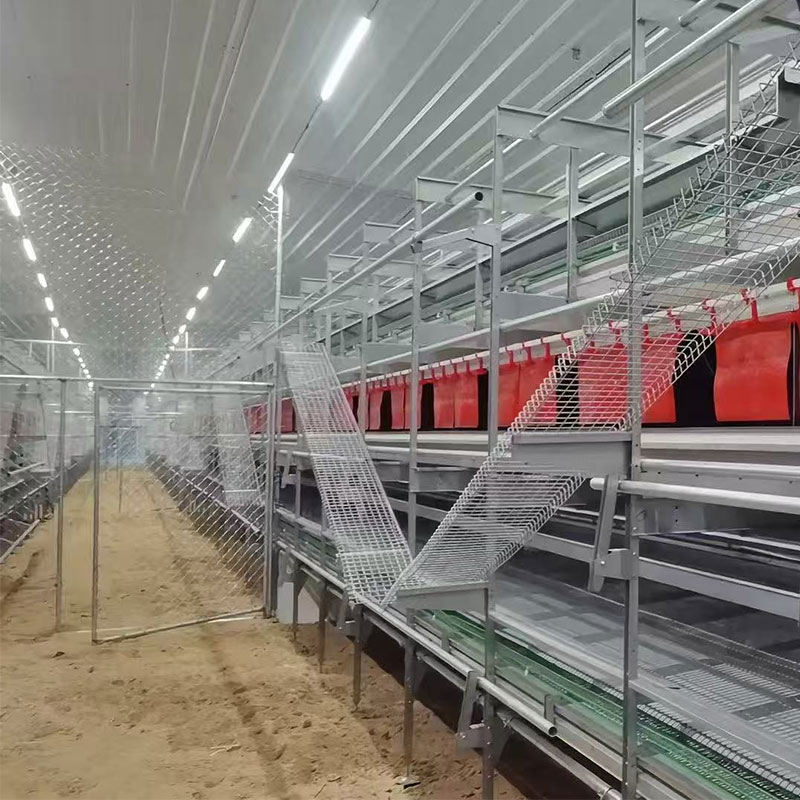
Features
- Dust baths: Hens instinctively clean feathers, reducing mites.
- Foraging trays: Encourage natural pecking behavior, decreasing boredom.
- Stronger bones: Perching strengthens legs compared to flat-wire cages.
Pros
- Premium egg markets: Qualifies for "cage-free" labels in some regions.
- Healthier birds: Fewer leg disorders and fatty liver disease.
Cons
- Expensive setup: Costs 20–30% more than battery cages.
- Slower ROI: Takes longer to offset initial costs through egg sales.
Best for: Niche markets (organic, free-range) or farms selling directly to consumers.
4. Free-Range and Aviary Systems: Maximum Welfare, Higher Labor
Free-range systems allow hens outdoor access, while aviaries keep them indoors but with multi-tiered platforms for flying and perching. Both require more land and labor but fetch higher egg prices.
Features
- Outdoor access: Hens graze on pasture, reducing feed costs by 15–20%.
- Natural behaviors: Dust-bathing, foraging, and flying reduce stress.
- Ventilation challenges: Open-air designs increase predator risks and weather exposure.
Pros
- Consumer appeal: "Pasture-raised" eggs sell at 2–3x conventional prices.
- Lower feed costs: Insects and greens supplement diets.
Cons
- Predator losses: Foxes, hawks, and raccoons target free-roaming hens.
- Inconsistent production: Egg laying drops in extreme heat/cold.
Best for: Small farms or brands marketing ethically sourced eggs.
Choosing the Right System: Considerations
1. Flock Size
- Under 1,000 hens: Free-range or aviaries.
- 1,000–50,000 hens: Colony or enriched cages.
- 50,000+ hens: Battery cages (where legal).
2. Budget
- Low-cost: Battery cages ($3–$5 per bird).
- Mid-range: Colony cages ($8–$12 per bird).
- High-investment: Free-range ($15+ per bird with land costs).
3. Market Demand
- Cheap commodity eggs → Battery cages.
- Supermarkets requiring welfare standards → Colony cages.
- Farmers' markets/organic stores → Free-range.
4. Climate
- Cold regions: Insulated barns with colony cages.
- Hot areas: Free-range with shade trees.
Final Thoughts
No single cage system fits every farm. Battery cages win on efficiency, colony cages balance welfare and output, and free-range appeals to ethical consumers. Assess your budget, target market, and labor capacity before investing. Upgrading cages can boost egg quality, bird health, and profits—choose wisely.
1. Drinking system include the water pipes, water pressure adjuster, drinking nipples, Waterline front-end device, dosing system etc, choose them according to customer's needs.
2. High-quality water drinking pipes, pressure regulating valves and water drinking nipples can effectively prevent the water leakage. Drinking system adopt the closed piping system, which can minimize the water pollution.
3. 360-degree drinking nipples provide adequate drinking water for poultry at all stages.
4. The automatic drinking water system mainly adopts the steel ball drinking nipple. lt uses imported high-grad stainless steel, POM resin, and APS engineering material, which is wearing resistant, and the durability can be used for long time.



1. Automatic feeding machine can be chosen between gantry and ladder feeding machine. Gantry type feeding machine is a relatively economical and practical machine with simple operation, remote control walking character, easy to manage.
2. Mechanical transmission device running smoothly, low noise, long service life.
3. With the use of automatic control, the feeding system can adjust the amount of material.
4. Feeding with arched structure, high carrying capacity, not easily deformed.
5. Saving man power, saving feed, greatly improving the efficiency of Large-scale farming.
6. The walking speed of gantry feeding machine is 9--12 m/min.




1. Manure removing system included scraper type and conveyor belt type, Which can reduce the labor intensity and labor cost, keep the chicken shed dry and clean.
2. A type chicken cage can use scraper type or conveyor belt type.


3. The scraper type is suitable for A type cages, which can clean two or three rows. For the starters, this type is a good choice. lt can not only save some labor cost, but also save some investment in the whole project. The cleaning speed is 6-10 meters per minute.
4. Conveyor belt type is more suitable for large scale farming. The manure removing belt we use is high quality PP material (polypropylene). The walking speed is 2-4 meters per minute.



High Quality Pellets Made by Mobile Pellet Machine
1. It has professional designed angle of the blade. After the dynamic balance test one by one, the blade can operate smoothly.
2. The air volume is consistent in the whole life of the fan. Bearings has advantage of high strength, low noise, durable and so on.
1. The cooling pads uses high-quality wet curtain paper and adopts space cross-linking technology, which has the advantages of high water absorption, high water resistance, anti-toxicity and long service life.
2. The cooling efficiency is over 80%, without surfactant, natural water absorption, fast diffusion speed and long-lasting effect.
3. The product does not contain phenol and other chemical substances that are easy to cause skin allergies. It is non-toxic and harmless to the human body and chicken when installed and used. It is green, safe, energy-saving, environmentally friendly, economical, and easy to install.
4. The frame aluminum alloy has high strength, good corrosion resistance, durability and beautiful appearance.
5. Use a special filter for the cooling pad at the upper water to ensure clean water quality and support efficient water circulation components.
6. Combined with a negative pressure fan, it can effectively lower the indoor temperature.
The window is made of special selected high-quality engineering plastic, with high strength and long service life, together with superior anti-aging and anti-UV performance.
Function: Ventilation of the chicken house, usually used in the winter.
This system can adjust the wind speed and direction, thus the cold air will not reach chicken directly , which can effectively prevent the phenomenon of cold stress in chicken.
Environmental control system equipment is suitable for large-scale and intensive farming. According to customer requirements, we can provide various types of smart poultry equipment.
1. Our poultry management system is a modular system that manages all aspects of the chicken house, such as climate, temperature, humidity, ammonia, feeding, feed weighing, lighting and ventilation systems, and can monitor the situation of the chicken house in real time through a computer and mobile phone.
2. The management computer is the heart of the poultry farm, allowing you to easily monitor the entire poultry farm.

 WeChat:+8617838608255