The Ultimate Guide to Broiler Chicken Cages: Systems, Welfare, and Best Practices
For poultry farmers and agricultural professionals, selecting the right housing system is one of the most critical decisions impacting broiler health, productivity, and farm profitability. The term "cages for broiler chicken" often sparks debate, as modern poultry production has evolved far beyond traditional battery cage concepts. Today's options range from enriched colony systems to various cagefree alternatives, each with distinct implications for bird welfare, operational efficiency, and meat quality. This comprehensive guide delves into the world of broiler housing, examining the different cage and pen systems available, analyzing their pros and cons through the lenses of animal science and business economics, and outlining evidencebased best practices for successful broiler rearing. Whether you're a seasoned farmer optimizing your setup or a new entrant planning your first house, understanding these systems is fundamental to running a responsible and sustainable operation.
The landscape of broiler chicken production is diverse. It's essential to clarify terminology, as "cage" can mean different things in different contexts.
In commercial broiler (meat chicken) production, the use of traditional stacked wire cages—common in layer hen operations—is relatively rare and increasingly phased out due to welfare concerns. Instead, broilers are typically reared in one of three primary systems:
1. Conventional Floor System (OpenSided or Environmentally Controlled Houses): This is the global industry standard. Birds are reared on a littercovered floor (e.g., wood shavings, rice hulls) at a controlled density. They have freedom to move, perch (if perches are provided), and express natural behaviors like dust bathing.
2. Enriched Colony Systems (Sometimes referred to as "Cages"): These are larger, more complex enclosures that provide resources like perches, scratch areas, and nesting spaces. They are more common in some regions for pullets or layers but are less frequently used for standard broilers due to rapid growth rates and space requirements.
3. MultiTier or Aviary Systems: Gaining traction in some markets, these systems utilize vertical space with slatted or wire floors over manure belts. They provide platforms and perches at different levels. While initially developed for layers, adapted versions are being explored for slowergrowing broiler breeds.
For the purpose of this guide focused on broiler chickens, we will primarily address Conventional Floor Systems and touch on emerging alternatives.
Selecting a housing system is not onesizefitsall. It involves balancing multiple factors.
Modern welfare standards emphasize the "Five Freedoms":
Freedom from hunger/thirst.
Freedom from discomfort (requiring appropriate environment and resting space).
Freedom from pain/injury/disease.
Freedom to express normal behavior.
Freedom from fear/distress.
A good housing system must facilitate these. Floor systems with enriched environments (perches, pecking objects) score well here.
This is a crucial metric measured in kg/m² or ft²/bird.
Lower Density: Promotes better air quality, litter condition, and mobility; reduces heat stress and leg issues.
Higher Density: Maximizes building utilization but risks welfare compromises like poor litter quality (leading to footpad dermatitis), increased ammonia levels, and heat stress.
Industry certifications (e.g., Global Animal Partnership, RSPCA Assured) often mandate specific maximum densities.
Broilers generate significant heat and moisture. The system must allow for:
Effective temperature management (from brooders to cooling).
Highvolume ventilation to remove ammonia (NH3), carbon dioxide (CO2), and dust.
Uniform air distribution across the entire flock to prevent "microclimates."
Consider daily tasks:
Ease of bird catching during harvest.
Manure management: Deep litter vs. belt removal systems.
Feed & water access: Automated chain/bulk feeders vs pan feeders; nipple drinker lines.
Biosecurity: How does the system facilitate cleaning/disinfection between flocks?
The capital expenditure (CAPEX) versus operational expenditure (OPEX). A hightech climatecontrolled house has high CAPEX but can lower mortality rates (%)and improve feed conversion ratio (FCR), boosting OPEX efficiency.
Since this is the predominant system globally let's explore its components as they relate to "caging" or enclosing birds effectively within a house.
A welldesigned house acts as a macrocage that protects birds from predators/elements while providing a controlled environment.
| Feature | Importance | Best Practice |
| : | : | : |
| Insulation | Critical for temperature stability & energy efficiency | Walls/ceiling with high Rvalue; prevents condensation |
| Curtains / Inlets | Provide fresh air; light control | Automated based on static pressure; ensure even inlet airflow |
| Fans & Tunnel Ventilation | Heat stress removal during hot weather | Proper fan capacity (CFM) matched to bird mass at peak summer |
| Heating System | Brooding chicks (~32°C initial) | Radiant brooders or forcedair heaters; ensure even heat zone |
| Cooling Systems | Evaporative cooling pads (Cellulose/PVC) | Used with tunnel ventilation; maintain pad cleanliness |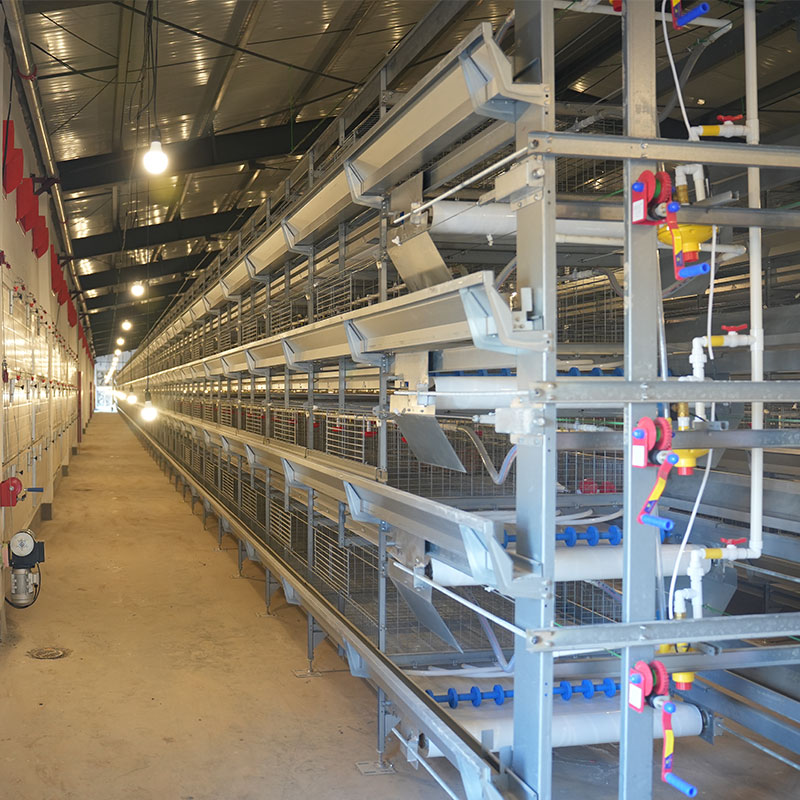
Poor litter equals poor health.
Material: Absorbent materials like pine shavings are ideal.
Management: Litter must be kept dry (<25% moisture) to control ammonia (<25 ppm) levels which cause respiratory issues (like ascites)and eye damage (keratoconjunctivitis) .
Caking occurs when moisture combines with feces; caked litter must be removed promptly.
Windrowing between flocks can help dry litter via microbial activity.
Lines should be accessible within ~3 meters (~10 ft) of every bird.
1st Week: Use supplementary chick feeders/drinkers placed directly under brooders alongside main lines.
Consumer demand is driving innovation beyond standard floor systems.
Programs like GAP Step 2+ require environmental enrichments:
for pecking/scratching, perches (low height), or platforms to encourage activity.and reduced fearfulness.These systems use vertical space:
The ideal "cage" for broiler chickens is less about confinement bars than it is about creating an optimized environment that balances biological needs with practical husbandry . For most producers , mastering the conventional floor system—with meticulous attention to ventilation , stocking density , litter management , enrichment —remains key . Staying informed on evolving welfare science , consumer preferences , technological advancements like precision livestock farming sensors monitoring realtime data will separate forwardthinking operations from those left behind . Ultimately success lies not simply selecting type structure but committing excellence daily management within chosen system ensuring birds healthy productive meeting ethical economic goals simultaneously possible achievable through knowledge dedication outlined this guide .
Q1: Are broiler chickens kept in cages?
A: In most largescale commercial production globally , broilers are not kept in traditional stacked wire cages . They are predominantly reared large openfloor barns loose litter where move freely . Some alternative multitier aviarystyle systems exist but represent minority current market share .
Q2: What is difference between battery cages used layers housing used broilers ?
A: Battery cages small wire enclosures designed maximize egg collection minimize cost historically used laying hens . Broiler housing focuses maximizing growth rate feed efficiency typically involving open barn space where birds interact directly with litter environment .
Q3: What stocking density recommended broilers ?
A: Recommendations vary by certification program region . Common baseline around ~33 kg/m² (~0 .75 ft²/lb live weight ) equivalent roughly ~20 birds/m² (~1 .8 ft²/bird ) market weight ~2 .5 kg Higherwelfare programs require lower densities e g ~30 kg/m² less .
Q4: How important ventilation broiler house ?
A: Critically important arguably single most important management factor after providing feed water Proper ventilation removes excess heat moisture harmful gases ammonia ensures uniform oxygen supply preventing respiratory disease promoting good litter quality .
Q5 Can I use perches enrichments fastgrowing broilers ?
A Yes increasingly encouraged Perches should low height wide flat profile accommodate heavier body weight reduce risk injury Enrichments like bales pecking objects stimulate activity potentially improving leg health reducing behavioral issues Important monitor ensure enrichments remain clean functional .
Q6 What main advantages conventional floor system ?
A Advantages include lower initial capital cost compared hightech systems flexibility managing flock size wellestablished management protocols allows expression natural behaviors scratching dust bathing when managed properly good welfare outcomes possible .
Q7 What main disadvantages conventional floor system ?
A Disadvantages include potential poor litter quality if mismanaged leading footpad lesions higher ammonia levels greater disease transmission risk contact feces difficulty catching birds harvest requires more labor compared automated tiered systems possibly lower building space utilization efficiency .
Q8 How often should clean out replace litter between flocks ?
A Complete cleanout recommended least once year typically after cycles However partial removal top caked layer windrowing remaining litter common practice between every flock goal maintain dry friable condition always prioritize bird health over costsaving shortcuts regarding litter management .
Q9 Are there regulations governing use cages broilers ?
A Regulations vary significantly by country state Many jurisdictions specifically prohibit use traditional cages meat chickens European Union certain US states passed laws requiring cagefree environments Always check local agricultural animal welfare authorities understand specific legal requirements your operation location .
Q10 Do cagefree freerange mean same thing ?
A No Cagefree means birds reared inside building without cages typically openfloor system Freerange implies cagefree plus requirement continuous daytime access outdoor pasture areas which brings its own set management challenges predators biosecurity etc Both distinct from conventional caged systems largely obsolete meat production anyway context previously explained earlier article sections above here now concluding FAQ list thank you reading hope informative useful your farming endeavors sincerely author team writing this content piece today date published online digitally web format blog post page website internet etc...
1. Drinking system include the water pipes, water pressure adjuster, drinking nipples, Waterline front-end device, dosing system etc, choose them according to customer's needs.
2. High-quality water drinking pipes, pressure regulating valves and water drinking nipples can effectively prevent the water leakage. Drinking system adopt the closed piping system, which can minimize the water pollution.
3. 360-degree drinking nipples provide adequate drinking water for poultry at all stages.
4. The automatic drinking water system mainly adopts the steel ball drinking nipple. lt uses imported high-grad stainless steel, POM resin, and APS engineering material, which is wearing resistant, and the durability can be used for long time.



1. Automatic feeding machine can be chosen between gantry and ladder feeding machine. Gantry type feeding machine is a relatively economical and practical machine with simple operation, remote control walking character, easy to manage.
2. Mechanical transmission device running smoothly, low noise, long service life.
3. With the use of automatic control, the feeding system can adjust the amount of material.
4. Feeding with arched structure, high carrying capacity, not easily deformed.
5. Saving man power, saving feed, greatly improving the efficiency of Large-scale farming.
6. The walking speed of gantry feeding machine is 9--12 m/min.




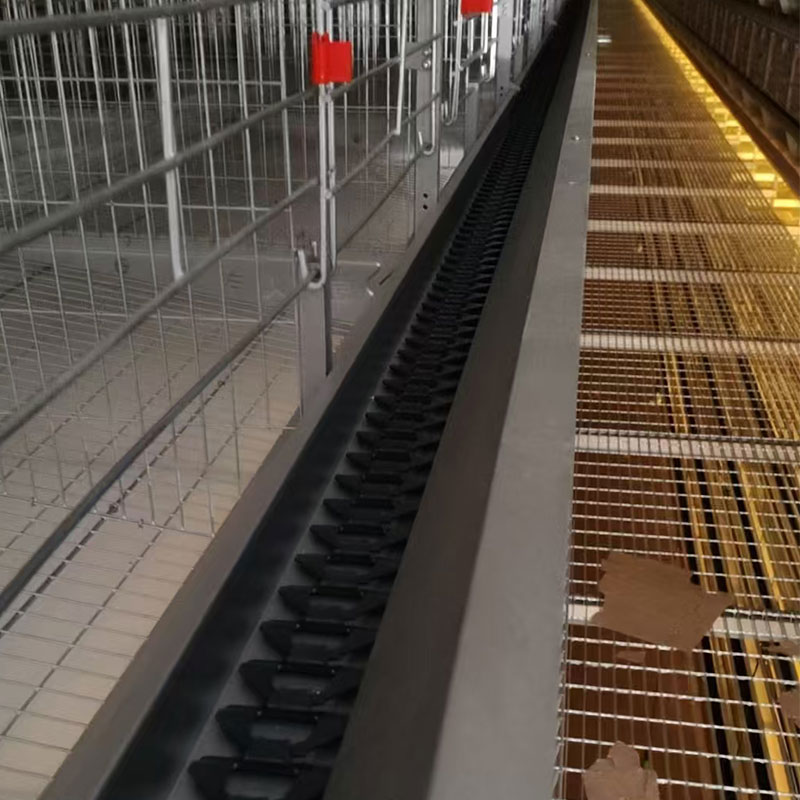
1. Manure removing system included scraper type and conveyor belt type, Which can reduce the labor intensity and labor cost, keep the chicken shed dry and clean.
2. A type chicken cage can use scraper type or conveyor belt type.


3. The scraper type is suitable for A type cages, which can clean two or three rows. For the starters, this type is a good choice. lt can not only save some labor cost, but also save some investment in the whole project. The cleaning speed is 6-10 meters per minute.
4. Conveyor belt type is more suitable for large scale farming. The manure removing belt we use is high quality PP material (polypropylene). The walking speed is 2-4 meters per minute.



High Quality Pellets Made by Mobile Pellet Machine
1. It has professional designed angle of the blade. After the dynamic balance test one by one, the blade can operate smoothly.
2. The air volume is consistent in the whole life of the fan. Bearings has advantage of high strength, low noise, durable and so on.
1. The cooling pads uses high-quality wet curtain paper and adopts space cross-linking technology, which has the advantages of high water absorption, high water resistance, anti-toxicity and long service life.
2. The cooling efficiency is over 80%, without surfactant, natural water absorption, fast diffusion speed and long-lasting effect.
3. The product does not contain phenol and other chemical substances that are easy to cause skin allergies. It is non-toxic and harmless to the human body and chicken when installed and used. It is green, safe, energy-saving, environmentally friendly, economical, and easy to install.
4. The frame aluminum alloy has high strength, good corrosion resistance, durability and beautiful appearance.
5. Use a special filter for the cooling pad at the upper water to ensure clean water quality and support efficient water circulation components.
6. Combined with a negative pressure fan, it can effectively lower the indoor temperature.
The window is made of special selected high-quality engineering plastic, with high strength and long service life, together with superior anti-aging and anti-UV performance.
Function: Ventilation of the chicken house, usually used in the winter.
This system can adjust the wind speed and direction, thus the cold air will not reach chicken directly , which can effectively prevent the phenomenon of cold stress in chicken.
Environmental control system equipment is suitable for large-scale and intensive farming. According to customer requirements, we can provide various types of smart poultry equipment.
1. Our poultry management system is a modular system that manages all aspects of the chicken house, such as climate, temperature, humidity, ammonia, feeding, feed weighing, lighting and ventilation systems, and can monitor the situation of the chicken house in real time through a computer and mobile phone.
2. The management computer is the heart of the poultry farm, allowing you to easily monitor the entire poultry farm.

 WeChat:+8617838608255