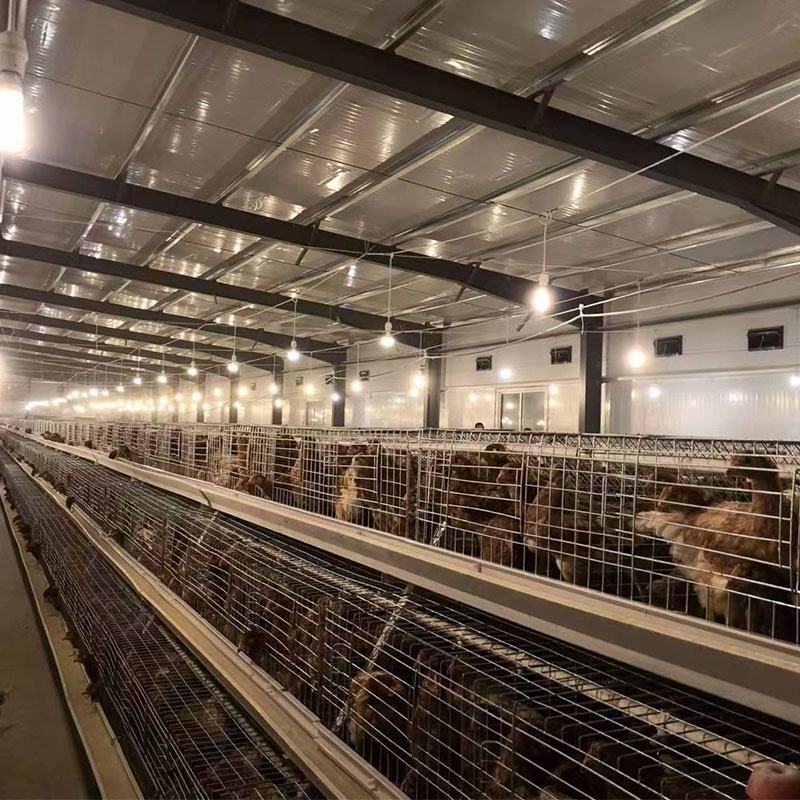
The low hum of ventilation fans and the steady rustle of feeding chains are the sounds of a modern broiler operation running at peak efficiency. For decades, the industry standard has been the open-floor house, a vast space where birds roam freely. While this method has its history, a growing number of producers are turning their attention upward, to a system that redefines spatial dynamics: multi-tier cage systems for broilers. This isn't merely about stacking birds; it's a fundamental re-engineering of the production environment that directly impacts the metrics that matter most—feed conversion, bird health, and operational control.
The core principle of a broiler cage system is verticality. Instead of a single ground-level plane, the house is equipped with two, three, or even four tiers of cages, each a self-contained environment. Picture a series of large, open-fronted pens stacked like shelves in a warehouse. Each tier has its own dedicated watering line, feeding system, and manure removal belt. The birds live on a comfortable plastic or wire mesh floor, and their droppings fall through onto a continuous belt that runs beneath each level. This simple architectural shift away from a single litter floor creates a cascade of operational advantages.
Perhaps the most immediate and calculable benefit is the radical improvement in land and building utilization. A farmer with a 40x400-foot house is no longer limited to the square footage of the concrete pad. By installing three tiers, they effectively triple the usable growing area within the same building envelope. This doesn’t automatically mean tripling the bird count, as proper stocking density per square meter of cage floor space is maintained, but it allows for a significant increase in total output without the prohibitive cost of constructing new buildings. For a producer looking to expand output on a fixed land base, this is a transformative proposition. The capital investment is in the equipment, not in new concrete, steel, and roofing.
This vertical design directly confronts one of the most persistent challenges in open-floor production: litter quality. In a traditional house, the birds live on, and constantly interact with, their own manure. As a flock cycle progresses, moisture from droppings and drinkers accumulates in the litter. This damp bedding becomes a breeding ground for pathogens like E. coli and Clostridium, and generates ammonia gas. High ammonia levels burn the birds’ eyes and respiratory tracts, suppressing their immune systems and making them susceptible to diseases like avian influenza. It also leads to footpad dermatitis—lesions on the underside of the foot—a major welfare concern and a quality downgrade at the processing plant.
A cage system with manure belts severs this contact. The droppings are removed from the bird’s living space, often on a daily or even more frequent basis. A farmer can start a new flock on a perfectly clean, dry floor and maintain that dry environment for the entire grow-out. The result is a dramatic reduction in ammonia. Walking into a cage house during the fifth week of a flock is a different experience; the air is noticeably clearer. This improved air quality translates directly to healthier birds. There is a marked decrease in respiratory issues, and the incidence of footpad lesions plummets, leading to a higher percentage of Grade A carcasses. The birds are not spending energy fighting off constant environmental challenges; that energy is diverted toward growth.
This leads to the second major advantage: enhanced feed conversion ratios (FCR). In an open house, broilers are active. They move to feeders and drinkers, and they exhibit natural foraging behaviors, which includes scratching in the litter. All this activity consumes calories. In a cage environment, the necessities of life—feed, water, and a comfortable climate—are delivered with extreme consistency and with minimal effort required from the bird. The feeder is never more than a step or two away. This reduction in unnecessary energy expenditure means more of the feed consumed is dedicated to building muscle. It is not uncommon for producers using well-managed cage systems to see FCR improvements of several points compared to their open-house averages. Over tens of thousands of birds per year, saving a few grams of feed per bird per day amounts to a substantial financial saving.
The controlled environment of a cage system also revolutionizes flock management and biosecurity. When a disease challenge does appear, it is far easier to contain within a single tier or even a single cage module than it is to stop its spread across an entire open floor. During vaccination or culling procedures, workers have vastly improved access to every bird. There is no chasing animals around a large pen; each bird is within easy reach, reducing stress on both the animal and the handler. This controlled access simplifies daily mortality collection, allowing for quicker removal and better disease monitoring.
For the farm staff, the ergonomics of the job are improved. Many tasks that once required bending or kneeling to floor level are now performed at waist height. Checking water nipples, adjusting feeders, and inspecting birds become less physically demanding. Furthermore, the automation integrated into these systems reduces labor requirements. Automated feeding chains deliver a consistent ration on a set schedule. The manure belts can be programmed to run at specific intervals, removing waste without manual scraping. Centralized climate control systems, which are more effective in the sealed environment of a cage house, manage temperature, humidity, and ventilation, reducing the need for constant manual adjustment of curtains and fans.
When considering the purchase of a broiler cage system, it is a decision that requires careful evaluation of several key technical aspects. The system is not a single product but an integrated suite of components that must work in harmony.
Structural Framework and Cages: The backbone of the system is the galvanized steel framework. This must be engineered to bear the immense weight of the cages, the equipment, and the birds themselves across a wide span without intermediate supports that would hinder machinery. The cages are typically constructed from heavy-gauge, corrosion-resistant wire or solid plastic panels. The flooring is a critical component; it must be strong enough to support the birds while having a mesh size that allows manure to pass through easily without trapping feet. The design should eliminate sharp edges and include features like adjustable dividers to create pens of the optimal size.

Feeding System: Unlike a single line serving an entire house, a multi-tier system requires a feeding line for each level. These are typically chain-driven systems. The chain runs in a trough, delivering a fresh wave of feed from the silo out to the end of the house and back. The consistency and timing of this delivery are paramount. The feed must be evenly distributed along the entire length of the trough to ensure every bird has equal access. Modern systems are controlled by sophisticated software that can manage the number of daily feeds, portion sizes, and even trigger special feeding programs for different growth stages.
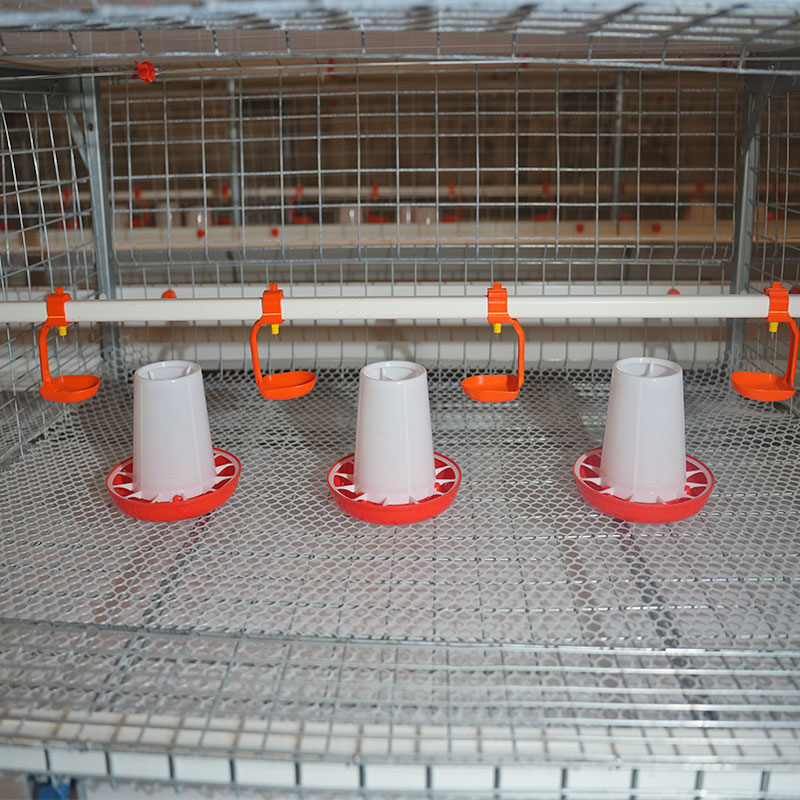
Watering System: Each tier has its own independent water line fitted with nipple drinkers. The water pressure must be meticulously calibrated. Too low, and birds at the end of the line won’t get enough water; too high, and the nipples will leak, creating wet spots and defeating one of the primary benefits of the system. The lines must be mounted at the precise height relative to the birds’ backs to encourage proper drinking behavior and minimize spillage.
Manure Removal System: This is the component that enables the core benefit of improved hygiene. Beneath each tier, a continuous PVC or rubber belt runs the length of the house. These belts are programmed to operate periodically, transporting the dry manure to one end of the building where it is scraped off into a cross-conveyor or a collection wagon. The frequency of operation is crucial—often enough to keep the manure dry and prevent ammonia release, but not so often that it wastes energy. Some systems can run the belts multiple times a day, while in drier climates, once daily may be sufficient. The collected manure, being dry and separated from litter, is a more valuable, nutrient-dense fertilizer.
Ventilation and Climate Control: A cage house operates more like a sealed, positive-pressure environment than a traditional curtain-sided house. The stacked tiers create microclimates; heat rises, so the top tier will naturally be warmer than the bottom. The ventilation system must be powerful and intelligent enough to manage this stratification. This is typically achieved with a combination of inlet fans, stirring fans located between the tiers to mix the air, and exhaust fans. The entire system is managed by a climate computer that reacts to sensors measuring temperature and humidity at different levels, ensuring a uniform environment throughout the house.
The decision to transition to a cage system is a significant capital investment. The cost per bird housed will be higher than the cost of a simple open-house setup. However, the economic analysis must be based on total cost of production, not just upfront capital. The return on investment is realized through the aggregation of margins: reduced mortality from improved health, savings from a lower FCR, higher yields from better carcass quality, reduced labor costs through automation, and the value of the improved manure byproduct. For a high-volume producer, these operational savings can justify the initial expenditure in a relatively short period.
Broiler cage systems represent a maturation of poultry production technology. They offer a path to greater efficiency, enhanced bird health, and improved working conditions by fundamentally rethinking the relationship between the bird and its environment. It is a solution built not on complexity for its own sake, but on a logical, engineered approach to eliminating the variables that hinder performance in traditional systems. For the forward-thinking poultry farmer, it is an investment in precision, control, and the future of their operation.
1. Drinking system include the water pipes, water pressure adjuster, drinking nipples, Waterline front-end device, dosing system etc, choose them according to customer's needs.
2. High-quality water drinking pipes, pressure regulating valves and water drinking nipples can effectively prevent the water leakage. Drinking system adopt the closed piping system, which can minimize the water pollution.
3. 360-degree drinking nipples provide adequate drinking water for poultry at all stages.
4. The automatic drinking water system mainly adopts the steel ball drinking nipple. lt uses imported high-grad stainless steel, POM resin, and APS engineering material, which is wearing resistant, and the durability can be used for long time.



1. Automatic feeding machine can be chosen between gantry and ladder feeding machine. Gantry type feeding machine is a relatively economical and practical machine with simple operation, remote control walking character, easy to manage.
2. Mechanical transmission device running smoothly, low noise, long service life.
3. With the use of automatic control, the feeding system can adjust the amount of material.
4. Feeding with arched structure, high carrying capacity, not easily deformed.
5. Saving man power, saving feed, greatly improving the efficiency of Large-scale farming.
6. The walking speed of gantry feeding machine is 9--12 m/min.




1. Manure removing system included scraper type and conveyor belt type, Which can reduce the labor intensity and labor cost, keep the chicken shed dry and clean.
2. A type chicken cage can use scraper type or conveyor belt type.


3. The scraper type is suitable for A type cages, which can clean two or three rows. For the starters, this type is a good choice. lt can not only save some labor cost, but also save some investment in the whole project. The cleaning speed is 6-10 meters per minute.
4. Conveyor belt type is more suitable for large scale farming. The manure removing belt we use is high quality PP material (polypropylene). The walking speed is 2-4 meters per minute.



High Quality Pellets Made by Mobile Pellet Machine
1. It has professional designed angle of the blade. After the dynamic balance test one by one, the blade can operate smoothly.
2. The air volume is consistent in the whole life of the fan. Bearings has advantage of high strength, low noise, durable and so on.
1. The cooling pads uses high-quality wet curtain paper and adopts space cross-linking technology, which has the advantages of high water absorption, high water resistance, anti-toxicity and long service life.
2. The cooling efficiency is over 80%, without surfactant, natural water absorption, fast diffusion speed and long-lasting effect.
3. The product does not contain phenol and other chemical substances that are easy to cause skin allergies. It is non-toxic and harmless to the human body and chicken when installed and used. It is green, safe, energy-saving, environmentally friendly, economical, and easy to install.
4. The frame aluminum alloy has high strength, good corrosion resistance, durability and beautiful appearance.
5. Use a special filter for the cooling pad at the upper water to ensure clean water quality and support efficient water circulation components.
6. Combined with a negative pressure fan, it can effectively lower the indoor temperature.
The window is made of special selected high-quality engineering plastic, with high strength and long service life, together with superior anti-aging and anti-UV performance.
Function: Ventilation of the chicken house, usually used in the winter.
This system can adjust the wind speed and direction, thus the cold air will not reach chicken directly , which can effectively prevent the phenomenon of cold stress in chicken.
Environmental control system equipment is suitable for large-scale and intensive farming. According to customer requirements, we can provide various types of smart poultry equipment.
1. Our poultry management system is a modular system that manages all aspects of the chicken house, such as climate, temperature, humidity, ammonia, feeding, feed weighing, lighting and ventilation systems, and can monitor the situation of the chicken house in real time through a computer and mobile phone.
2. The management computer is the heart of the poultry farm, allowing you to easily monitor the entire poultry farm.

 WeChat:+8617838608255