1. PAINPOINT DRIVEN OPENING
Are you managing a manual broiler cage operation and facing persistent bottlenecks that cap your profitability? Manual systems, while lower in initial investment, often create hidden costs that erode margins. Key challenges include:
Labor Inefficiency & High Operational Cost: Manual feeding, watering, and monitoring are laborintensive. This leads to high, recurring wage expenses and vulnerability to labor shortages, directly impacting your cost per bird.
Inconsistent Bird Performance: Manual feed distribution can be uneven, leading to competition at the trough and variable growth rates within a single flock. Inconsistent water access further compromises feed conversion ratios (FCR).
Elevated Bird Stress & Mortality: Frequent human entry for daily tasks increases bird stress, which can suppress immune function. Manual manure handling beneath cages often occurs while birds are present, raising ammonia levels and health risks.
Data Deficits for Decision Making: Relying on visual estimates for feed consumption, water intake, and growth metrics makes precise flock management impossible. You lack the data to optimize nutrition or identify health trends early.
Physical Strain & Worker Safety: Repetitive manual tasks like handling feed bags and cleaning cages contribute to worker fatigue and potential injury, affecting morale and increasing liability.
Is your operation struggling with unpredictable FCR, high labor turnover, and difficulty scaling production? The solution lies in strategically upgrading your core housing infrastructure.
2. PRODUCT OVERVIEW: Manual Broiler Cage Systems
Our manual broiler cage systems are engineered structural housing units designed for the efficient rearing of broiler chickens from chick placement to processing. These systems prioritize durability, bird welfare, and operational logic for farms utilizing manual daily management.
Operational Workflow:
1. Chick Placement: Dayold chicks are placed into the tiered cage system, which includes integrated feeding trays and drinking lines.
2. Daily Manual Management: Operators manually top up feed hoppers or distribute feed along the trough line. Water pressure is checked at the header tank or manifold. Birds are visually inspected during these routines.
3. Manure Handling: A manure belt or drop pan system collects waste. This is manually cleared at intervals appropriate to the growout cycle.
4. Bird Removal (Catching): At the end of the cycle, birds are manually removed from the cages for transport.
Application Scope & Limitations:
This equipment is ideally suited for small to midscale commercial broiler operations seeking an organized, durable housing system over floor rearing, but where full automation is not yet justified by scale or investment parameters. It is less suitable for operations with severe chronic labor shortages or those targeting ultrahighvolume throughput with minimal staff.
3. CORE FEATURES
Galvanized Steel Mesh Flooring | Technical Basis: Electrogalvanized steel wire grid with precise gap spacing | Operational Benefit: Provides secure footing for birds, allows manure to pass through cleanly, and prevents breast blisters | ROI Impact: Reduces bird condemnations at processing and extends cage floor lifespan beyond 15 years.
Centralized Feed Trough with Adjustable Height | Technical Basis: Corrosionresistant trough mounted on a cable or chain height adjustment system | Operational Benefit: Allows the feed line to be raised in sync with bird growth, ensuring easy access while minimizing waste | ROI Impact: Improves feed accessibility, contributing to a more uniform FCR across the flock.
Nipple Drinking System with Pressure Regulator | Technical Basis: Stainless steel nipple drinkers fed by a PVC line with an inline pressure regulator and visual water meter | Operational Benefit: Delivers clean water on demand, reducing spillage and pen wetness compared to cup or bell drinkers | ROI Impact: Lower water usage improves litter quality in manure collection areas; better hydration supports optimal feed conversion.
Modular Tier Design with Manure Belts | Technical Basis: Hotdip galvanized Aframe structure supporting multiple tiers, each equipped with a removable PVCcoated manure belt | Operational Benefit: Maximizes floor space utilization; belts contain waste between cleanouts, improving house air quality | ROI Impact: Increases stock density per square meter of building; reduces labor time for major cleandown between flocks.
Reinforced Door Latches & Partition Panels | Technical Basis: Heavyduty steel latch mechanisms and removable partition panels | Operational Benefit: Secures birds during operations and allows flexible configuration of pen sizes for different batch quantities | ROI Impact: Minimizes bird escape during inspection/catching; offers operational flexibility without custom fabrication.
4. COMPETITIVE ADVANTAGES
| Performance Metric | Industry Standard (Basic Cage) | Our Manual Broiler Cage Solution | Advantage (% improvement) |
| : | : | : | : |
| Floor Durability (Lifespan) | 810 years (mild steel) | 15+ years (hotdip galvanized) | +50% lifespan |
| Feed Conversion Ratio (FCR) Support| Variable access leading to higher spread| Consistent trough height adjustment promotes uniform access| Field data shows 24 point improvement in FCR uniformity |
| Manure Management Labor Time| Full cleanout required between batches| Dry belt removal reduces contact time| Up to 30% reduction in intercycle cleaning labor |
| Stocking Density (per m² of house floor)| Limited by poor ventilation design| Optimized tier spacing for air flow| Allows 1520% higher density vs. flatdeck designs |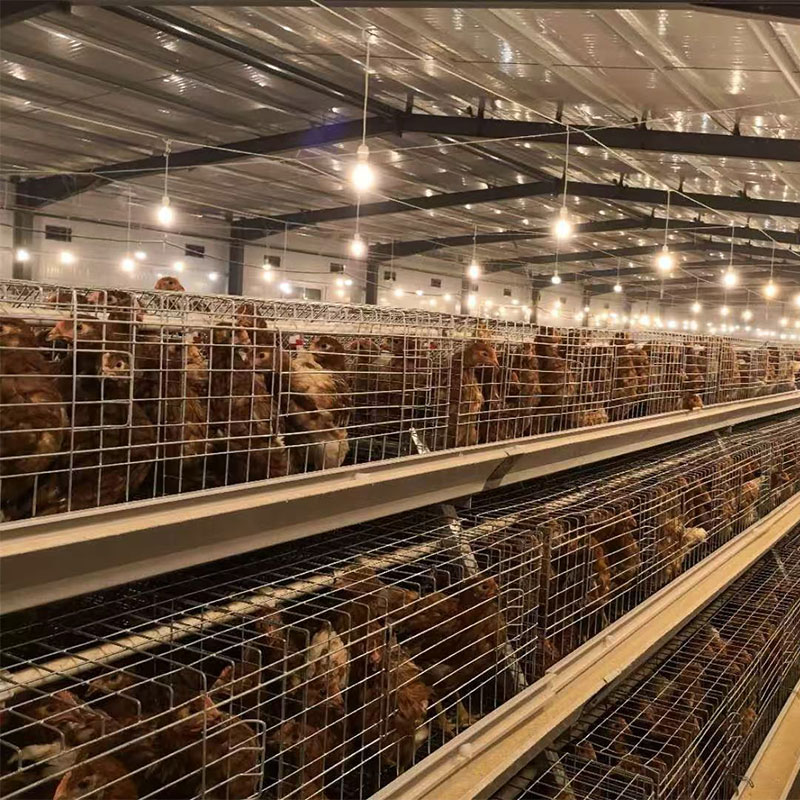
5. TECHNICAL SPECIFICATIONS
Capacity/Rating: Standard configurations support 3040 kg/m² live weight at end of cycle.
Power Requirements: Minimal; optional ventilation fans may require standard 220V singlephase connection.
Material Specifications: Primary structure: Hotdip galvanized steel (≥100g/m² coating). Mesh flooring: Electrogalvanized steel wire (φ2.5mm). Feed trough: Coated aluminum alloy.
Physical Dimensions: Single bay module typically measures W2000mm x L2500mm per tier. Common configurations are 3tier or 4tier Aframe systems.
Environmental Operating Range: Designed for operation within standard poultry house environments with controlled temperature (1828°C) and humidity (5070% RH).
6. APPLICATION SCENARIOS
7 COMMERCIAL CONSIDERATIONS
Equipment pricing is structured around modular components allowing customization
Base System Tier Includes hotdip galvanized frame mesh flooring basic nipple line
Enhanced System Tier Adds adjustable feed trough height mechanism PVCcoated manure belts
Optional Features Include integrated weighing scales supplemental lighting kits
Service packages range from basic technical documentation delivery through onsite supervision during assembly
Financing options can be discussed including leasing structures that allow payment alignment with flock cycles
8 FAQ
Q What level of existing poultry house preparation is required for installing this manual broiler cage system?
A The building requires a level concrete floor adequate ventilation infrastructure lighting points We provide detailed foundation layout drawings prior to delivery
Q How does this system impact daily labor requirements compared to deep litter?
A While not eliminating daily tasks it organizes them Labor shifts from spreading litter managing wet spots focused efficient feeding watering inspection along clear aisles reducing overall time per bird managed
Q Can components like nipple drinkers be retrofitted into older cage systems we own?
A Yes many components including drinking lines pressure regulators partition panels are designed with retrofit compatibility Consult our engineering team for specific assessment
Q What is the typical lead time from order confirmation delivery?
A For standard configurations lead time averages between weeks depending on order volume Custom configurations may require additional engineering time
Q Are training materials provided for our stockmen?
A Yes comprehensive operation maintenance manuals provided We also recommend at least one day onsite training during commissioning cover proper adjustment daily checks troubleshooting procedures
1. Drinking system include the water pipes, water pressure adjuster, drinking nipples, Waterline front-end device, dosing system etc, choose them according to customer's needs.
2. High-quality water drinking pipes, pressure regulating valves and water drinking nipples can effectively prevent the water leakage. Drinking system adopt the closed piping system, which can minimize the water pollution.
3. 360-degree drinking nipples provide adequate drinking water for poultry at all stages.
4. The automatic drinking water system mainly adopts the steel ball drinking nipple. lt uses imported high-grad stainless steel, POM resin, and APS engineering material, which is wearing resistant, and the durability can be used for long time.



1. Automatic feeding machine can be chosen between gantry and ladder feeding machine. Gantry type feeding machine is a relatively economical and practical machine with simple operation, remote control walking character, easy to manage.
2. Mechanical transmission device running smoothly, low noise, long service life.
3. With the use of automatic control, the feeding system can adjust the amount of material.
4. Feeding with arched structure, high carrying capacity, not easily deformed.
5. Saving man power, saving feed, greatly improving the efficiency of Large-scale farming.
6. The walking speed of gantry feeding machine is 9--12 m/min.




1. Manure removing system included scraper type and conveyor belt type, Which can reduce the labor intensity and labor cost, keep the chicken shed dry and clean.
2. A type chicken cage can use scraper type or conveyor belt type.


3. The scraper type is suitable for A type cages, which can clean two or three rows. For the starters, this type is a good choice. lt can not only save some labor cost, but also save some investment in the whole project. The cleaning speed is 6-10 meters per minute.
4. Conveyor belt type is more suitable for large scale farming. The manure removing belt we use is high quality PP material (polypropylene). The walking speed is 2-4 meters per minute.



High Quality Pellets Made by Mobile Pellet Machine
1. It has professional designed angle of the blade. After the dynamic balance test one by one, the blade can operate smoothly.
2. The air volume is consistent in the whole life of the fan. Bearings has advantage of high strength, low noise, durable and so on.
1. The cooling pads uses high-quality wet curtain paper and adopts space cross-linking technology, which has the advantages of high water absorption, high water resistance, anti-toxicity and long service life.
2. The cooling efficiency is over 80%, without surfactant, natural water absorption, fast diffusion speed and long-lasting effect.
3. The product does not contain phenol and other chemical substances that are easy to cause skin allergies. It is non-toxic and harmless to the human body and chicken when installed and used. It is green, safe, energy-saving, environmentally friendly, economical, and easy to install.
4. The frame aluminum alloy has high strength, good corrosion resistance, durability and beautiful appearance.
5. Use a special filter for the cooling pad at the upper water to ensure clean water quality and support efficient water circulation components.
6. Combined with a negative pressure fan, it can effectively lower the indoor temperature.
The window is made of special selected high-quality engineering plastic, with high strength and long service life, together with superior anti-aging and anti-UV performance.
Function: Ventilation of the chicken house, usually used in the winter.
This system can adjust the wind speed and direction, thus the cold air will not reach chicken directly , which can effectively prevent the phenomenon of cold stress in chicken.
Environmental control system equipment is suitable for large-scale and intensive farming. According to customer requirements, we can provide various types of smart poultry equipment.
1. Our poultry management system is a modular system that manages all aspects of the chicken house, such as climate, temperature, humidity, ammonia, feeding, feed weighing, lighting and ventilation systems, and can monitor the situation of the chicken house in real time through a computer and mobile phone.
2. The management computer is the heart of the poultry farm, allowing you to easily monitor the entire poultry farm.

 WeChat:+8617838608255