
For poultry farmers navigating the transition from traditional floor rearing to high-density production, the integration of automated cage systems represents a fundamental shift in daily operations and long-term profitability. The modern layer cage, far from being a simple enclosure, functions as a self-contained habitat engineered to manage the critical variables of hen health and egg production. When evaluating an automatic frame chicken cage with scientific breeding and egg-turning capabilities, it is essential to understand how its individual components work in concert to create a controlled environment.
The structural integrity of the system begins with the frame. Typically constructed from hot-dipped galvanized steel, this framework is designed to resist the corrosive ammonia-rich atmosphere of the poultry house. A farmer will notice the difference not in a glossy finish, but in the absence of rust flakes contaminating the litter below and the longevity of the structure, which can withstand years of daily washdowns and sanitation cycles. The cage floors are not solid sheets but rather welded wire mesh, with a specific slope—often around 8 degrees. This incline is not arbitrary; it is calculated to allow a laid egg to roll gently away from the hen without gaining enough momentum to crack against the collection tray. The spacing of the wires is precise: wide enough for manure to fall through, yet narrow enough to provide secure footing for the birds, preventing foot injuries and promoting confident movement.
Feeding is transformed from a labor-intensive chore into a continuous, monitored process. An automated feeding system consists of a chain or auger that travels along a trough running the length of each cage tier. A central hopper holds the feed, and the system is programmed to run at set intervals throughout the day. This does more than just save labor. It ensures every hen has simultaneous access to fresh feed, eliminating the pecking order dominance that can leave weaker birds undernourished in manual systems. Farmers can observe a more uniform flock body weight as a result. The feed trough itself is designed with a lip that minimizes spillage, a critical detail that directly translates into lower feed conversion ratios and reduced waste.
Water delivery is equally sophisticated. Nipple drinking systems are the standard, with stainless steel nipples positioned at strategic intervals. When a hen is thirsty, she pecks at the pin protruding from the nipple, which releases a droplet of water directly into her beak. This closed system is a stark contrast to open troughs. It prevents water from being contaminated with feed, litter, or manure, drastically reducing the pathway for diseases like E. coli or salmonella. The water lines are connected to a central regulator and a medicator, allowing a farmer to easily administer vaccines, vitamins, or medications through the entire flock's water supply in a single action, ensuring uniform dosage.
Perhaps the most visually distinct feature of a scientific breeding cage is the manure removal system. Beneath each tier of cages, a series of scrapers or conveyor belts are installed. These are timed to run multiple times a day, automatically moving the accumulated droppings to one end of the house and into a collection pit or cross-conveyor. The immediate benefit is the dramatic improvement in air quality. By removing the primary source of ammonia, the system reduces respiratory stress on the birds. Healthier lungs mean a more robust immune system and better utilization of feed for egg production instead of fighting illness. For the farmer, it means entering a house without the eye-watering sting of ammonia and dealing with manure as a managed byproduct rather than a daily accumulation.

The "automatic egg-turning" function refers to the incubation process, which is a separate but integrated component for farms engaged in hatching their own chicks. This is not a feature of the layer cages themselves but of dedicated incubation rooms. Here, eggs are stored in specialized trays that gently tilt back and forth at precise intervals, mimicking the natural behavior of a broody hen. This rotation is not a minor detail; it prevents the embryo from sticking to the inner shell membrane, which would be fatal. It also ensures the embryo receives nutrients and heat evenly, leading to a stronger, more viable chick and a higher hatch rate. For a breeder farm, this automation guarantees a consistent and reliable output of day-old chicks, turning eggs into a predictable product stream.
Environmental control is the nervous system of the automated coop. A central control panel, often accessible via a touchscreen or even a smartphone app, is the command center. Sensors placed throughout the house continuously monitor temperature, humidity, and air quality. If the temperature rises above a set point, the panel can activate tunnel ventilation fans, drawing a swift breeze the length of the building. Simultaneously, evaporative cooling pads at the air inlets can be engaged, lowering the incoming air temperature by several degrees through water evaporation. This prevents heat stress, a condition that causes hens to pant, stop eating, and consequently, cease laying. In winter, the system manages minimum ventilation rates, bringing in just enough fresh air to exhaust moisture and ammonia without creating a draft that chills the birds. This precise climate management creates a stable, season-less environment inside the coop, which is directly correlated with consistent year-round egg production.
The layout and stocking density within these cages are a direct application of scientific breeding principles. Birds are grouped in small numbers per cage compartment to allow for adequate feeder and drinker space. This prevents overcrowding, which is a primary trigger for feather pecking and cannibalism. The design encourages natural behaviors in a controlled manner; hens can stand, sit, and access resources without competition. The result is a calmer flock. A calm bird does not waste energy on stress or aggression; that energy is redirected into egg production. Furthermore, the segregated design makes individual bird monitoring and culling of non-productive hens a more manageable task, improving the overall efficiency and health status of the flock.
The economic implications of adopting such a system are profound, but they extend beyond simple labor savings. The initial capital outlay is significant, encompassing the cost of the cages, feeding and watering systems, manure conveyors, and environmental controllers. However, the return on investment is calculated through multiple channels. Labor costs are perhaps the most obvious reduction. What once required several workers for hours each day—feeding, watering, and egg collection—is now managed by automated systems and periodic monitoring. This freed-up labor can be redirected to higher-value tasks like flock health surveillance, maintenance of the equipment, and business management.
Feed efficiency shows a marked improvement. With reduced spillage and the ability to provide a balanced diet on demand, farmers often document a drop in their feed conversion ratio—the amount of feed required to produce a dozen eggs. In a business where feed can constitute 60-70% of the total operating cost, a few percentage points of improvement have a substantial impact on the bottom line.
Manure management transitions from a disposal problem to a potential revenue stream. Because the automated scrapers remove manure with little contamination from litter or feathers, the end product is a relatively pure, dry material that is more valuable as an organic fertilizer. It can be bagged and sold to horticultural operations, creating an additional income source that partially offsets operating costs.
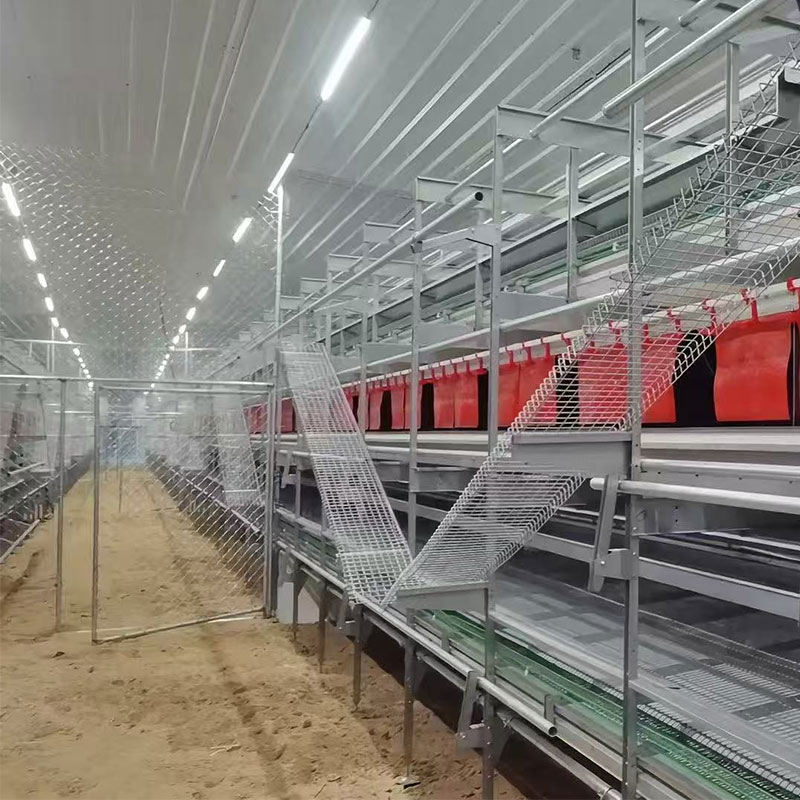
The most critical financial metric, however, is egg production and quality. A hen living in a stable, low-stress environment with optimal access to feed and water will produce closer to her genetic potential. The automated egg collection system, where eggs roll onto a soft conveyor belt and are gently transported to a central collection room, results in a dramatic reduction in cracks and checks. A single cracked egg can lose over half its value. By delivering a higher percentage of Grade A, clean, intact eggs to the packing facility, the system directly increases the revenue per hen housed.
Disease control is an often-overlooked financial benefit. The closed nipple drinking system, the removal of manure from the living area, and the physical separation of birds from their waste drastically lower the pathogen load in the environment. This translates into fewer disease outbreaks, reduced mortality rates, and lower veterinary bills. Furthermore, the need for antibiotics can be significantly reduced, which is increasingly important for meeting consumer demands and regulatory standards for antibiotic-free production.
The implementation of this technology requires a shift in management mindset. The farmer becomes a systems manager and data analyst. Instead of manually checking feed bins, they are monitoring power consumption of the feeding motors and calibrating feed delivery times. Instead of judging temperature by feel, they are analyzing data logs from the environmental controller to fine-tune settings for different seasons or flock ages. Maintenance is paramount; a failed bearing on a feed auger or a stuck manure scraper can escalate from a minor repair into a major welfare and production issue within hours. A proactive maintenance schedule, including regular lubrication, belt tension checks, and sensor calibration, is non-negotiable for realizing the system's full potential.
Training staff to understand the cause-and-effect relationships within the automated house is crucial. They must be able to recognize the sound of a struggling motor, interpret an alarm from the control panel, and understand how a clogged nipple drinker in one section can impact the water pressure for an entire row. This depth of understanding ensures that the technology serves the flock and not the other way around.
The transition to an automated frame cage system is a capital-intensive and technically demanding endeavor. It is not merely a purchase of equipment but an investment in a new methodology of poultry farming. The rewards, however, are a scale of efficiency, product quality, and operational control that is unattainable with traditional methods. It allows a farm to precisely align the biological needs of the chicken with the economic requirements of a modern agricultural business, creating a sustainable model for future growth.
1. Drinking system include the water pipes, water pressure adjuster, drinking nipples, Waterline front-end device, dosing system etc, choose them according to customer's needs.
2. High-quality water drinking pipes, pressure regulating valves and water drinking nipples can effectively prevent the water leakage. Drinking system adopt the closed piping system, which can minimize the water pollution.
3. 360-degree drinking nipples provide adequate drinking water for poultry at all stages.
4. The automatic drinking water system mainly adopts the steel ball drinking nipple. lt uses imported high-grad stainless steel, POM resin, and APS engineering material, which is wearing resistant, and the durability can be used for long time.



1. Automatic feeding machine can be chosen between gantry and ladder feeding machine. Gantry type feeding machine is a relatively economical and practical machine with simple operation, remote control walking character, easy to manage.
2. Mechanical transmission device running smoothly, low noise, long service life.
3. With the use of automatic control, the feeding system can adjust the amount of material.
4. Feeding with arched structure, high carrying capacity, not easily deformed.
5. Saving man power, saving feed, greatly improving the efficiency of Large-scale farming.
6. The walking speed of gantry feeding machine is 9--12 m/min.




1. Manure removing system included scraper type and conveyor belt type, Which can reduce the labor intensity and labor cost, keep the chicken shed dry and clean.
2. A type chicken cage can use scraper type or conveyor belt type.


3. The scraper type is suitable for A type cages, which can clean two or three rows. For the starters, this type is a good choice. lt can not only save some labor cost, but also save some investment in the whole project. The cleaning speed is 6-10 meters per minute.
4. Conveyor belt type is more suitable for large scale farming. The manure removing belt we use is high quality PP material (polypropylene). The walking speed is 2-4 meters per minute.



High Quality Pellets Made by Mobile Pellet Machine
1. It has professional designed angle of the blade. After the dynamic balance test one by one, the blade can operate smoothly.
2. The air volume is consistent in the whole life of the fan. Bearings has advantage of high strength, low noise, durable and so on.
1. The cooling pads uses high-quality wet curtain paper and adopts space cross-linking technology, which has the advantages of high water absorption, high water resistance, anti-toxicity and long service life.
2. The cooling efficiency is over 80%, without surfactant, natural water absorption, fast diffusion speed and long-lasting effect.
3. The product does not contain phenol and other chemical substances that are easy to cause skin allergies. It is non-toxic and harmless to the human body and chicken when installed and used. It is green, safe, energy-saving, environmentally friendly, economical, and easy to install.
4. The frame aluminum alloy has high strength, good corrosion resistance, durability and beautiful appearance.
5. Use a special filter for the cooling pad at the upper water to ensure clean water quality and support efficient water circulation components.
6. Combined with a negative pressure fan, it can effectively lower the indoor temperature.
The window is made of special selected high-quality engineering plastic, with high strength and long service life, together with superior anti-aging and anti-UV performance.
Function: Ventilation of the chicken house, usually used in the winter.
This system can adjust the wind speed and direction, thus the cold air will not reach chicken directly , which can effectively prevent the phenomenon of cold stress in chicken.
Environmental control system equipment is suitable for large-scale and intensive farming. According to customer requirements, we can provide various types of smart poultry equipment.
1. Our poultry management system is a modular system that manages all aspects of the chicken house, such as climate, temperature, humidity, ammonia, feeding, feed weighing, lighting and ventilation systems, and can monitor the situation of the chicken house in real time through a computer and mobile phone.
2. The management computer is the heart of the poultry farm, allowing you to easily monitor the entire poultry farm.

 WeChat:+8617838608255