For poultry farmers, the perimeter fence represents the first and most crucial line of defense. It’s the barrier that separates a thriving, productive flock from a host of external threats. While many materials are available, hexagonal galvanized mesh, commonly known as chicken wire, has remained a staple on farms for generations. Its application, however, extends far beyond simply unrolling a roll around the coop. Understanding its properties, strengths, and limitations is essential for creating a secure and durable enclosure.
The defining characteristic of this mesh is its hexagonal pattern. When you stretch it between posts, these hexagons distribute pressure. If a predator pushes against one section, the tension is absorbed by the surrounding hexagons, preventing a localized failure. This is different from a rigid welded grid, which can bend permanently under similar pressure. The flexibility of the hexagons allows the fence to give slightly under impact, like a net, and then spring back into shape. This is particularly useful in areas with curious wildlife or during high winds, where a more rigid structure might become permanently deformed.
The term "galvanized" refers to the zinc coating applied to the steel wire. This isn't just a paint or a thin layer; it’s a metallurgical bond that sacrificially protects the underlying steel. Imagine a light rain falling on a galvanized fence. The zinc coating reacts with water and air first, forming a protective patina that shields the steel from rust. Even if the surface gets a small scratch, the surrounding zinc continues to protect the exposed area, preventing a rust spot from spreading. A farmer will see the difference over time. An uncoated wire fence might show significant rust within a single season in a humid climate, becoming weak and brittle. A properly galvanized mesh, however, will retain its strength and appearance for years, with only a gradual dulling of its initial shiny finish. The quality of this galvanization is key. A heavier coating, often measured in ounces per square foot, will always provide longer-lasting protection than a thin, cheaply applied one.
When selecting the mesh for a poultry run, the gauge of the wire and the size of the hexagons are the primary considerations. The gauge is a number that indicates the thickness of the wire; a lower number means a thicker, stronger wire. For instance, a 20-gauge wire is relatively thin and lightweight, suitable for creating temporary internal dividers or protecting seedlings in a garden from birds. For a main perimeter fence meant to deter determined predators like raccoons or foxes, a 19-gauge or even a heavier 16-gauge wire is a far more robust choice. Trying to stretch a thin 20-gauge fence taut without it sagging or tearing is difficult, whereas a 19-gauge wire provides the necessary rigidity.
The hexagon opening size is equally critical. A one-inch mesh is excellent for containing newly hatched chicks or preventing mice from entering the coop. However, for a general poultry enclosure, a two-inch mesh is a common and versatile choice. It is strong enough to resist the weight of a climbing raccoon—their paws can get caught in the openings, deterring them—while still preventing chickens from sticking their heads through, which can lead to injury. A farmer who uses a mesh with openings larger than two inches might find that younger pullets can squeeze through, or that predators can reach a paw through more easily to snatch a bird that is standing too close to the fence.
Installation is where the theoretical benefits of the mesh are tested in practice. The flexibility that makes it resilient also makes it challenging to install tautly. Simply stapling it to wooden posts will result in a sagging, ineffective fence within weeks. The correct method involves using rigid metal T-posts or sturdy wooden posts as the main structural supports. The mesh should be unrolled and attached to the line posts, but the real tension is created at the corner posts.
Corner posts must be exceptionally robust, often braced in an "H" or "diagonal" configuration to withstand the immense pull of a tightly stretched fence. Using a come-along or a fence stretcher, the mesh is pulled tight and secured to these braced corners. Any slack left in the fence becomes a weakness, a place where a predator can push through or where the wind can cause damage. Along the line posts, the mesh should be secured with galvanized staples on wooden posts or with galvanized wire ties on metal T-posts, ensuring it cannot be easily peeled back from the bottom.
The most common point of failure in a poultry fence is not the mesh itself, but the perimeter. A determined fox or dog will dig under a fence long before it tries to break through it. To counter this, an "apron" is essential. This involves bending the bottom 12 to 18 inches of the mesh outward at a 90-degree angle away from the coop and burying it shallowly, or securing it flat to the ground with landscape staples. When a predator starts to dig at the fence line, it immediately encounters this underground barrier. This simple technique is often the single most effective upgrade a farmer can make to a wire mesh enclosure.
While excellent for creating a perimeter, hexagonal mesh has limitations when used for cage systems or coop walls. Its flexibility means it cannot support significant weight. If used as the floor of a elevated cage, it will sag under the weight of the birds, leading to potential foot and leg problems. For cage construction, a heavier, welded wire grid with smaller openings is a more appropriate choice as it provides a stable, flat walking surface. Similarly, using the lightweight mesh as the primary wall of a coop offers little protection from cold winds and driven rain. It is best used as an outer layer over a solid coop wall for added predator proofing, or as the primary material for well-ventilated covered runs.
The mesh also serves a dual purpose in managing the flock's environment and protecting other farm assets. It can be used to create segregated areas within a larger run. A farmer can separate a broody hen and her chicks from the main flock, or isolate a bird that is being bullied, without the need for building a permanent wall. In a free-range system, a temporary fence made from lighter gauge mesh and step-in posts can be used to practice rotational grazing, moving the birds to fresh pasture regularly while protecting the previously used area to allow for regrowth.
Furthermore, this fencing is invaluable for protecting gardens and young trees. Chickens are natural foragers and will quickly decimate vegetable seedlings and scratch away the soil from the roots of saplings. A simple barrier of mesh around a garden plot or individual trees allows a farmer to integrate poultry into a diversified homestead without conflict between the birds and the crops.

Maintenance of a galvanized mesh fence is minimal but important. An annual walk-around the perimeter is a good practice. The farmer should look for any signs of rust starting to form, particularly around cuts or at ground level. These small spots can be touched up with a zinc-rich cold galvanizing compound to halt their progress. They should check for any sags in the fence and re-tighten the wire ties or staples. It’s also crucial to inspect the bottom edge and the apron for any areas where erosion or animal digging may have exposed the wire or created a gap. Trimming back grass and weeds that grow directly against the fence not only improves its appearance but also removes cover for rodents and slows down the moisture-related degradation of the wire.

The longevity of the installation is directly proportional to the quality of the initial setup and the materials used. Investing in a heavier-gauge, well-galvanized mesh from the outset, combined with robust corner bracing and a secure apron, will result in a fence that requires little more than occasional inspection for a decade or more. Conversely, a hastily installed fence made from lightweight materials will become a constant source of repairs and potential flock losses.
In the daily rhythm of farm life, a well-constructed fence becomes an unseen, silent partner in flock management. It provides the foundational security that allows birds to express their natural behaviors—scratching, dust bathing, and foraging—without constant threat. It gives the farmer peace of mind, knowing that the investment in their birds is protected from the most common dangers. By selecting the right specifications of hexagonal galvanized mesh and dedicating time to its proper installation, a poultry farmer builds more than just a fence; they build a stable and secure environment essential for a productive and sustainable operation.
1. Drinking system include the water pipes, water pressure adjuster, drinking nipples, Waterline front-end device, dosing system etc, choose them according to customer's needs.
2. High-quality water drinking pipes, pressure regulating valves and water drinking nipples can effectively prevent the water leakage. Drinking system adopt the closed piping system, which can minimize the water pollution.
3. 360-degree drinking nipples provide adequate drinking water for poultry at all stages.
4. The automatic drinking water system mainly adopts the steel ball drinking nipple. lt uses imported high-grad stainless steel, POM resin, and APS engineering material, which is wearing resistant, and the durability can be used for long time.



1. Automatic feeding machine can be chosen between gantry and ladder feeding machine. Gantry type feeding machine is a relatively economical and practical machine with simple operation, remote control walking character, easy to manage.
2. Mechanical transmission device running smoothly, low noise, long service life.
3. With the use of automatic control, the feeding system can adjust the amount of material.
4. Feeding with arched structure, high carrying capacity, not easily deformed.
5. Saving man power, saving feed, greatly improving the efficiency of Large-scale farming.
6. The walking speed of gantry feeding machine is 9--12 m/min.




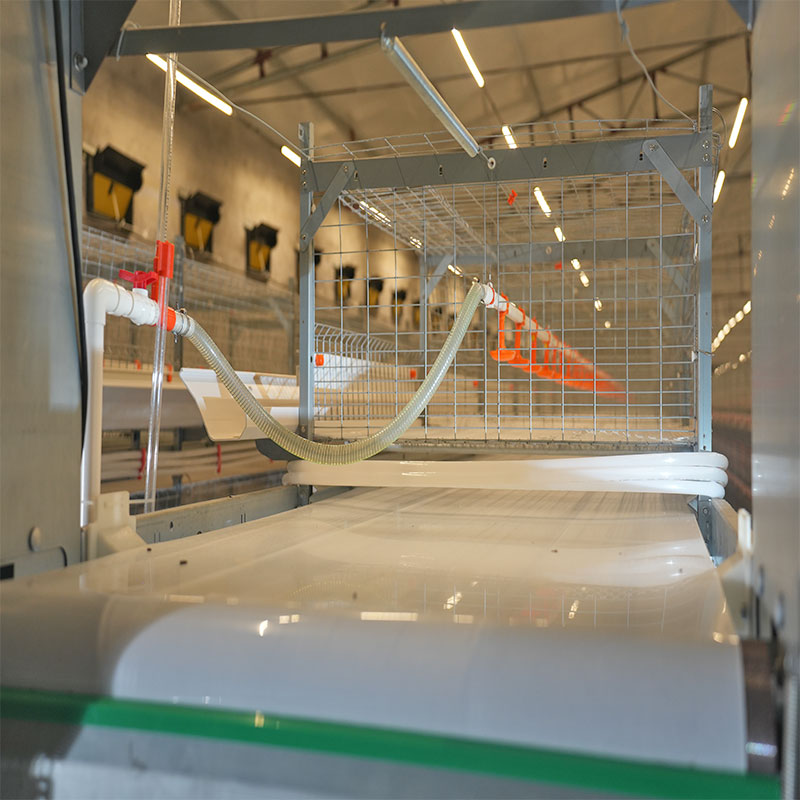
1. Manure removing system included scraper type and conveyor belt type, Which can reduce the labor intensity and labor cost, keep the chicken shed dry and clean.
2. A type chicken cage can use scraper type or conveyor belt type.


3. The scraper type is suitable for A type cages, which can clean two or three rows. For the starters, this type is a good choice. lt can not only save some labor cost, but also save some investment in the whole project. The cleaning speed is 6-10 meters per minute.
4. Conveyor belt type is more suitable for large scale farming. The manure removing belt we use is high quality PP material (polypropylene). The walking speed is 2-4 meters per minute.



High Quality Pellets Made by Mobile Pellet Machine
1. It has professional designed angle of the blade. After the dynamic balance test one by one, the blade can operate smoothly.
2. The air volume is consistent in the whole life of the fan. Bearings has advantage of high strength, low noise, durable and so on.
1. The cooling pads uses high-quality wet curtain paper and adopts space cross-linking technology, which has the advantages of high water absorption, high water resistance, anti-toxicity and long service life.
2. The cooling efficiency is over 80%, without surfactant, natural water absorption, fast diffusion speed and long-lasting effect.
3. The product does not contain phenol and other chemical substances that are easy to cause skin allergies. It is non-toxic and harmless to the human body and chicken when installed and used. It is green, safe, energy-saving, environmentally friendly, economical, and easy to install.
4. The frame aluminum alloy has high strength, good corrosion resistance, durability and beautiful appearance.
5. Use a special filter for the cooling pad at the upper water to ensure clean water quality and support efficient water circulation components.
6. Combined with a negative pressure fan, it can effectively lower the indoor temperature.
The window is made of special selected high-quality engineering plastic, with high strength and long service life, together with superior anti-aging and anti-UV performance.
Function: Ventilation of the chicken house, usually used in the winter.
This system can adjust the wind speed and direction, thus the cold air will not reach chicken directly , which can effectively prevent the phenomenon of cold stress in chicken.
Environmental control system equipment is suitable for large-scale and intensive farming. According to customer requirements, we can provide various types of smart poultry equipment.
1. Our poultry management system is a modular system that manages all aspects of the chicken house, such as climate, temperature, humidity, ammonia, feeding, feed weighing, lighting and ventilation systems, and can monitor the situation of the chicken house in real time through a computer and mobile phone.
2. The management computer is the heart of the poultry farm, allowing you to easily monitor the entire poultry farm.

 WeChat:+8617838608255