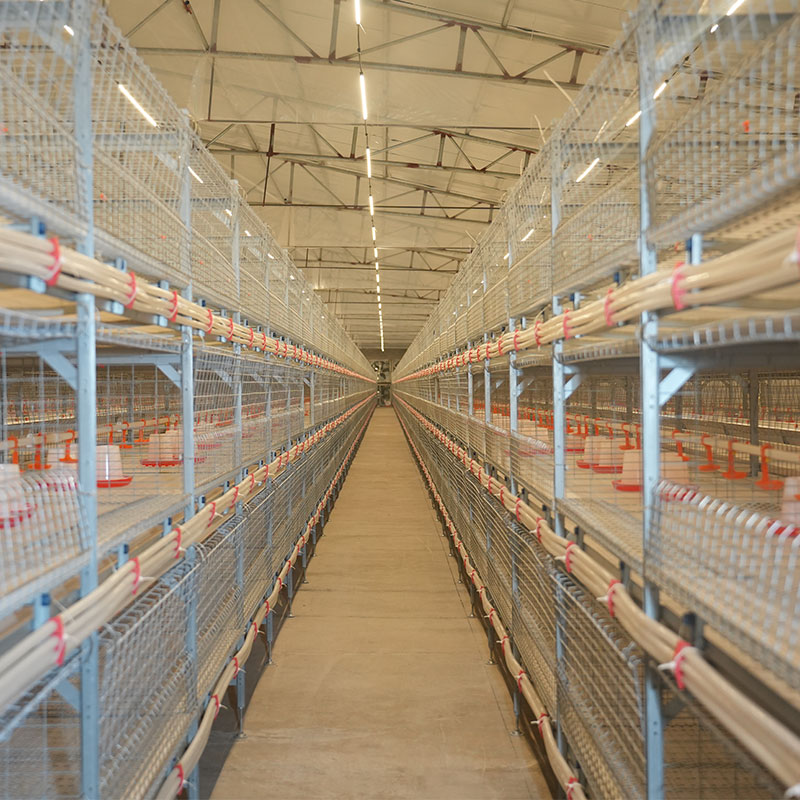
For poultry farmers who have spent years wrestling with flimsy wire cages that sag under the weight of active layers, the daily routine is all too familiar. The constant tightening of bolts, the patching of bent mesh after a startled flock piles into one corner, and the frustrating egg loss through damaged cage floors are not just minor inconveniences; they are direct hits to productivity and profitability. The design and construction of your layer cage system form the backbone of your entire operation, influencing everything from bird health and egg quality to labor efficiency and long-term financial viability.
The introduction of the Durable 4-Layer Steel Poultry Battery Cage with 4 Doors, built in the New H & A Type configuration, represents a significant shift in the available technology. This system is engineered not as a simple enclosure, but as a complete habitat designed to address the core challenges of modern, high-density egg production.
The Foundation: Decoding the "H & A Type" Structure

Many farmers are familiar with the limitations of traditional A-frame cages. The "New H & A Type" terminology refers to a hybrid structural design that combines the strength of an H-frame with the efficient space utilization of an A-frame. Imagine the vertical support posts of the system forming a rigid "H" shape when viewed from the end. This provides immense lateral stability, preventing the entire bank of cages from swaying if birds on one side become agitated. Integrated into this H-frame is the slanted A-type roof for each tier.
This slanted roof is a critical feature. Unlike a flat top that can accumulate dust, moisture, and pests, the steeply angled roof ensures that any debris slides off. More importantly, it creates a defined air channel above each cage row. When you walk down the aisle, you'll notice that air can flow freely over the top of each tier, carrying away ammonia and moisture rather than letting it stagnate around the birds on the upper levels. This is a practical solution to the microclimate problems that can plague multi-tiered systems, where the top-level birds are subjected to heat and fume buildup.
Unpacking the "4-Layer" Vertical Design

The decision to utilize a four-tier system is a direct response to the economic reality of land and housing costs. By growing vertically, a farmer can effectively quadruple the bird capacity within the same building footprint. However, simply stacking cages on top of one another creates a host of management issues. The design of this system specifically mitigates the challenges of a multi-layer setup.
The vertical spacing between each tier is calculated to provide adequate headroom for the birds in the lower cages while allowing a worker of average height to comfortably access all levels for bird inspection, retrieval, and maintenance. A farmer shouldn’t need a ladder or have to contort themselves to see a hen on the bottom row. The manure removal system is also engineered for this verticality. With a manure drying plate installed beneath each tier, droppings from upper levels do not fall directly on the birds below. This is a fundamental improvement over older systems where lower-tier birds were constantly soiled, leading to dirty feathers, higher disease pressure, and increased stress.
The Core of Durability: Materials and Construction
The term "galvanized steel" is often used, but its practical meaning is resistance. This is not a thin, powder-coated wire that will chip and rust when scraped by a power washer or exposed to the corrosive ammonia in manure. The steel wire used in these cages is hot-dip galvanized, a process where the steel is immersed in a bath of molten zinc. This creates a thick, bonded layer that acts as a sacrificial shield. Even if the surface is scratched, the zinc protects the underlying steel. A farmer running a hand over the cage floor will feel the smooth, hard finish that prevents bumblefoot lesions and is impervious to pecking.
The gauge, or thickness, of the wire is another key factor. The supporting frames and cage floor grids are constructed from a heavier-gauge wire to bear the constant load without sagging. A sagging floor is more than an annoyance; it leads to eggs rolling unevenly, increasing the chance of cracks and preventing them from cleanly arriving at the collection tray. The vertical and horizontal wires are welded at every intersection, not just spot-welded at intervals. This creates a unified grid that behaves as a single, rigid sheet rather than a collection of loose wires, eliminating the weak points that lead to structural failure over time.
The 4-Door Configuration: A Revolution in Accessibility and Animal Welfare
Traditional cage rows with long, continuous fronts make catching individual birds a time-consuming and stressful ordeal for both the farmer and the entire flock. The four-door design fundamentally changes daily management. Each cage section is equipped with its own dedicated door.
Consider the task of vaccinating or inspecting a bird. Instead of having to reach deep into a long cage, startling a dozen other hens to grab the one you need, a worker simply opens a single, smaller door. This allows for precise and calm bird handling. The reduced disturbance means the flock remains calmer, which directly translates to less smothering, fewer panic-induced injuries, and a more consistent laying pattern.
This design also enhances flock management. If a section of birds is underperforming or showing signs of illness, they can be isolated and managed as a distinct group without affecting their neighbors. It facilitates all-in-all-out practices on a smaller scale within the house, allowing for targeted cleaning and depopulation. Furthermore, during the depopulation process at the end of the lay cycle, the ability to remove birds in small, controlled groups from four separate access points dramatically speeds up the process and minimizes bird stress and potential damage.
The Integrated Systems: Manure, Eggs, and Feed
A cage is only as good as the systems that support it. This model incorporates three critical subsystems that operate in concert with the cage structure itself.
The Manure Management System operates on the principle of separation and desiccation. Beneath each tier, a manure drying plate, often made of durable plastic, is set at a slight angle. Droppings from the birds above fall onto this plate. Because the plates are solid and slanted, the manure does not contact the birds in the cage below. The key is the air gap between the tiers. Natural ventilation or assisted airflow in the poultry house passes over these plates, drying the manure in place. This significantly reduces the volume and weight of the waste, cuts ammonia emissions by up to 70% compared to pit systems, and creates a more hygienic environment. When it's time to clean, the dried, cake-like manure is much easier to handle and remove.
The Egg Collection System is a study in gentle automation. The cage floor is precision-engineered to slope gently towards the front of the cage. The moment an egg is laid, it begins a slow, controlled roll outward. The front of the cage is rolled inward to form a cushioned lip, preventing the egg from simply dropping onto the egg tray. Instead, it rolls softly onto this collection tray. For farmers who have dealt with cracked eggs from sudden drops or "blind" cages where eggs roll out of sight, this seamless transfer is a major advantage. The eggs are laid clean and remain clean, gathered in an easily accessible tray for several times daily collection.
The Feeding and Watering System is designed for zero waste and constant access. A robust feed trough runs the entire length of the cage row at a height easily reached by the hens. It is typically equipped with an adjustable feed gate, allowing the farmer to control the depth of the feed line to ensure all birds have equal access without allowing them to scratch and waste it. The water system, usually nipple drinkers, is positioned within easy reach. Each activation delivers a drop of water directly into the bird's beak, keeping the litter dry and preventing the spread of waterborne pathogens. This closed system ensures that water consumption is efficient and wastage is virtually eliminated.
Economic and Operational Impact on the Farm
The initial investment in a system of this caliber must be justified by a tangible return. The economic benefits are realized through several channels.
Reduced Labor Costs are immediate. The ease of bird handling through the four doors, the efficient egg collection, and the low-maintenance manure system collectively slash the man-hours required for daily chores. A task that might have taken two workers several hours can often be accomplished by one in half the time.
Superior Feed Conversion Ratio (FCR) is a direct result of the controlled environment. Because the birds are not expending energy to stay warm in damp conditions or compete aggressively for feed and water, more of the nutritional energy from their feed is directed toward egg production. A difference of just a few points in FCR, when multiplied by thousands of birds over a 60-week laying cycle, represents a massive saving in feed costs, which typically constitutes over 60% of operational expenses.
The dramatic reduction in egg breakage cannot be overstated. A single percentage point decrease in cracked and uncollectable eggs can amount to thousands of dollars in recovered revenue annually for a mid-sized operation. The gentle roll-out system and durable cage floor are engineered specifically to protect this primary product.
Finally, the longevity of the system defines its true cost-effectiveness. While a cheaper, lightly galvanized cage might need replacement in 5-7 years, a heavily galvanized, robustly welded system like this one can remain in service for 15 years or more with basic maintenance. This spreads the capital cost over a much longer period, making the annualized cost of ownership significantly lower. It is an investment in infrastructure that pays dividends in reliability, bird welfare, and operational smoothness for over a decade, forming a stable foundation for a profitable and sustainable poultry enterprise.
1. Drinking system include the water pipes, water pressure adjuster, drinking nipples, Waterline front-end device, dosing system etc, choose them according to customer's needs.
2. High-quality water drinking pipes, pressure regulating valves and water drinking nipples can effectively prevent the water leakage. Drinking system adopt the closed piping system, which can minimize the water pollution.
3. 360-degree drinking nipples provide adequate drinking water for poultry at all stages.
4. The automatic drinking water system mainly adopts the steel ball drinking nipple. lt uses imported high-grad stainless steel, POM resin, and APS engineering material, which is wearing resistant, and the durability can be used for long time.



1. Automatic feeding machine can be chosen between gantry and ladder feeding machine. Gantry type feeding machine is a relatively economical and practical machine with simple operation, remote control walking character, easy to manage.
2. Mechanical transmission device running smoothly, low noise, long service life.
3. With the use of automatic control, the feeding system can adjust the amount of material.
4. Feeding with arched structure, high carrying capacity, not easily deformed.
5. Saving man power, saving feed, greatly improving the efficiency of Large-scale farming.
6. The walking speed of gantry feeding machine is 9--12 m/min.




1. Manure removing system included scraper type and conveyor belt type, Which can reduce the labor intensity and labor cost, keep the chicken shed dry and clean.
2. A type chicken cage can use scraper type or conveyor belt type.


3. The scraper type is suitable for A type cages, which can clean two or three rows. For the starters, this type is a good choice. lt can not only save some labor cost, but also save some investment in the whole project. The cleaning speed is 6-10 meters per minute.
4. Conveyor belt type is more suitable for large scale farming. The manure removing belt we use is high quality PP material (polypropylene). The walking speed is 2-4 meters per minute.



High Quality Pellets Made by Mobile Pellet Machine
1. It has professional designed angle of the blade. After the dynamic balance test one by one, the blade can operate smoothly.
2. The air volume is consistent in the whole life of the fan. Bearings has advantage of high strength, low noise, durable and so on.
1. The cooling pads uses high-quality wet curtain paper and adopts space cross-linking technology, which has the advantages of high water absorption, high water resistance, anti-toxicity and long service life.
2. The cooling efficiency is over 80%, without surfactant, natural water absorption, fast diffusion speed and long-lasting effect.
3. The product does not contain phenol and other chemical substances that are easy to cause skin allergies. It is non-toxic and harmless to the human body and chicken when installed and used. It is green, safe, energy-saving, environmentally friendly, economical, and easy to install.
4. The frame aluminum alloy has high strength, good corrosion resistance, durability and beautiful appearance.
5. Use a special filter for the cooling pad at the upper water to ensure clean water quality and support efficient water circulation components.
6. Combined with a negative pressure fan, it can effectively lower the indoor temperature.
The window is made of special selected high-quality engineering plastic, with high strength and long service life, together with superior anti-aging and anti-UV performance.
Function: Ventilation of the chicken house, usually used in the winter.
This system can adjust the wind speed and direction, thus the cold air will not reach chicken directly , which can effectively prevent the phenomenon of cold stress in chicken.
Environmental control system equipment is suitable for large-scale and intensive farming. According to customer requirements, we can provide various types of smart poultry equipment.
1. Our poultry management system is a modular system that manages all aspects of the chicken house, such as climate, temperature, humidity, ammonia, feeding, feed weighing, lighting and ventilation systems, and can monitor the situation of the chicken house in real time through a computer and mobile phone.
2. The management computer is the heart of the poultry farm, allowing you to easily monitor the entire poultry farm.

 WeChat:+8617838608255