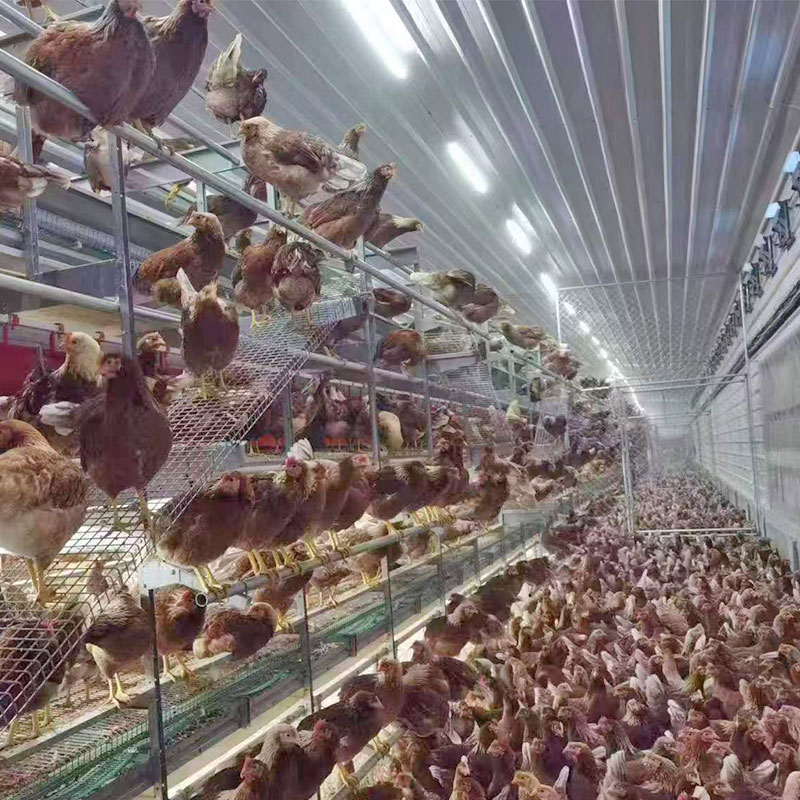
The landscape of poultry farming is undergoing a significant shift, moving from traditional floor-rearing methods toward more structured, efficient, and controlled environments. For broiler farmers facing the relentless pressures of feed costs, labor shortages, and market demands for higher welfare standards, the infrastructure housing their birds is no longer a passive shell but an active component of their operation's profitability. The H Type Broiler Chicken Cage system represents a fundamental rethinking of this space, transforming it into a multi-tiered, integrated production unit.
Unlike the single-plane approach of floor systems or the rigid, often cumbersome designs of older cage models, the H Type cage is characterized by its modular, vertical stacking. The namesake "H" shape is visible in the framework's profile: a central support column with cages extending symmetrically to either side, creating a structure that is both visually balanced and incredibly stable. This design is not merely for aesthetics; it is the foundation for a host of practical advantages that directly address the daily challenges of a modern broiler farm.
Maximizing Land and Building Utilization
The most immediate and calculable benefit of transitioning to an H Type system is the drastic increase in bird capacity without expanding the building's footprint. Consider a farmer with a 120-meter long, 12-meter wide house. A conventional floor system might stock 15,000 birds per flock. By installing three tiers of H Type cages, that same farmer can realistically house 45,000 to 50,000 birds. This tripling of capacity transforms the economics of the operation. The fixed costs of the building—rent, construction loans, insurance, and heating—are now amortized over a much larger number of birds, significantly reducing the overhead cost per kilogram of meat produced.
This vertical expansion must be paired with careful environmental management. The air inside a multi-tiered house behaves differently. Warm, moisture-laden air from the birds’ respiration will naturally rise to the ceiling. Without proper intervention, this creates a stratified environment: too hot and humid at the top, too cold and drafty at the bottom. Modern H Type systems are engineered for this challenge. They are integrated with negative pressure ventilation systems, where exhaust fans pull air uniformly from one end of the house, drawing fresh air through inlet openings along the opposite sidewall. This creates a consistent cross-breeze that travels horizontally across each tier, ensuring every bird, regardless of its level, experiences the same temperature, humidity, and air quality. It’s a controlled wind tunnel effect, meticulously calibrated to remove ammonia, dust, and excess heat while delivering fresh oxygen.
Precision Feeding and Watering: Eliminating Waste
Feed consistently represents over 65% of a broiler farmer’s operating costs. In a floor system, feed is presented in open pans or troughs, leaving it vulnerable to spoilage from moisture, contamination from manure, and simple spillage as birds scratch and flick it out. This wasted feed is money literally being trampled into the litter.
The H Type cage system attacks this problem with a closed-loop feeding mechanism. A long feed line, often a chain or spiral auger system, runs the length of each tier. It is housed within a fully enclosed trough, with an opening just large enough for a bird to access the feed with its head. The system operates on a timer, delivering a precise amount of feed at scheduled intervals throughout the day. Because the trough is covered, feed remains dry, clean, and untouched except by the beaks of the birds consuming it. Farmers report feed conversion ratios (FCR)—the measure of how many kilograms of feed it takes to produce one kilogram of live weight—improving by 5 to 10 points. On a 50,000-bird flock, this saving can amount to tens of thousands of dollars in feed costs per grow-out cycle.
Watering follows a similar principle of precision and hygiene. Nipple drinkers are standard, with one nipple serving a specific number of birds. When a bird pecks at the pin, it releases a droplet of water directly into its beak. This virtually eliminates the standing water found in bell drinkers, which becomes a soup of bacteria, vaccines, and medications, reducing their efficacy and promoting the spread of disease. The water in a closed nipple system remains potable and effective from the source to the last bird on the line.

Manure Management: From Problem to Resource
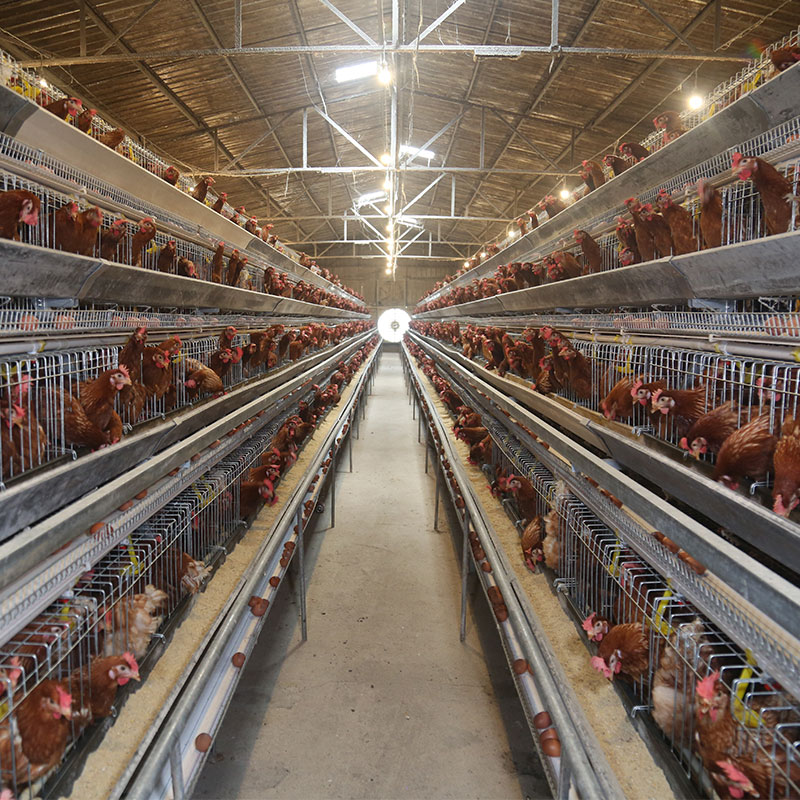
Manure handling is one of the most labor-intensive and odorous aspects of poultry farming. In a floor system, manure mixes with bedding material, creating a deep pack that must be completely cleaned out after each flock, a process that requires heavy equipment, significant time, and generates massive dust and ammonia spikes.
H Type cages incorporate a continuous manure removal system that operates daily. Beneath each tier of cages, a manure belt—a durable, slow-moving conveyor belt—is installed. Droppings fall through the cage floor onto this belt. Once or twice a day, the farmer activates the belt motor, and over the course of 15-20 minutes, the entire load of fresh manure is conveyed out of the house and into a dedicated collection trolley or pit. This daily removal is a game-changer. It prevents the buildup of ammonia, as the manure does not have time to break down significantly inside the living area. This leads to better bird health (ammonia burns respiratory tracts and predisposes birds to infection) and a vastly improved working environment for farm staff.
The collected manure is also in a much more valuable state. It is concentrated, uncontaminated by litter, and relatively dry. This makes it an ideal feedstock for composting or biogas digesters, turning a waste product into a saleable commodity or a source of renewable energy for the farm.
Bird Health and Welfare Considerations
The topic of cages often sparks debate around animal welfare, and rightly so. The modern H Type broiler cage is a far cry from the barren battery cages of old. Welfare is now a core design parameter. features include:
Space Allowance: Modern systems provide space allowances that meet or exceed animal welfare certification standards. Birds have sufficient room to stand, turn around, stretch their wings, and access feed and water without competition.
Environment: As detailed, the controlled environment drastically reduces aerial pollutants like ammonia and dust, which are major irritants. The closed feeding and watering systems minimize the spread of enteric diseases like coccidiosis and necrotic enteritis, which are often spread through contaminated litter.
Flooring: The cage floor is typically a welded mesh, designed with a specific gauge and slope to be comfortable on the birds’ feet and to allow manure to pass through easily, preventing footpad dermatitis.
Monitoring: The controlled nature of the system makes individual bird monitoring easier. A caretaker can walk the aisles and visually assess the health and condition of birds on every tier quickly, something that is impossible in a dense floor system where the majority of birds are obscured.
Operational Logistics and Automation
The H Type system is designed to streamline every step of the production cycle. For placement, day-old chicks are typically conveyed directly from the chick truck into the cages via a flexible tube system, distributing them evenly and with minimal stress and manual handling.
The harvest process, or depopulation, sees the greatest labor savings. In a floor system, catching crews must navigate a littered floor, manually catching and crating thousands of birds—a process that is stressful for both birds and people and can lead to high rates of bruising and dead-on-arrival birds. With an H Type system, the entire cage module can often be designed to integrate with the harvesting process. Some systems feature catching doors or even entire tiers that can be unlocked and tilted, allowing birds to be guided gently onto a conveyor belt that carries them smoothly to the waiting processing trucks. This reduces labor requirements by up to 50% and dramatically improves bird welfare during this final critical stage.
Financial Implications and Return on Investment
The decision to invest in an H Type Broiler Cage system is a major capital expenditure. The cost per bird space is significantly higher than the simple infrastructure required for a floor system. A thorough financial analysis is therefore essential. However, this analysis must look beyond the initial purchase price to the total cost of production.
The ROI is generated through the aggregation of the system's efficiencies:
Increased Revenue: More birds per cycle and the potential for more cycles per year due to faster, easier cleanout.
Reduced Variable Costs: Substantial savings on feed and medication.
Reduced Labor Costs: Drastic reductions in time spent on feeding, watering, manure cleaning, and bird catching.
Reduced Energy Costs: More efficient heating and ventilation per bird.
New Revenue Streams: Sale of clean, concentrated manure.
For many operations, the payback period for a fully automated H Type system can be achieved within 3 to 5 grow-out cycles, making it a sound long-term investment for a profitable and sustainable future.
The H Type Broiler Chicken Cage is not a one-size-fits-all solution, but for farmers aiming to scale their operation, tighten control over production variables, and navigate the evolving demands of the market, it offers a powerful and integrated framework for modern poultry production. It is a tool that turns space, feed, and labor into measurable efficiency, ensuring the farm's resilience for years to come.
1. Drinking system include the water pipes, water pressure adjuster, drinking nipples, Waterline front-end device, dosing system etc, choose them according to customer's needs.
2. High-quality water drinking pipes, pressure regulating valves and water drinking nipples can effectively prevent the water leakage. Drinking system adopt the closed piping system, which can minimize the water pollution.
3. 360-degree drinking nipples provide adequate drinking water for poultry at all stages.
4. The automatic drinking water system mainly adopts the steel ball drinking nipple. lt uses imported high-grad stainless steel, POM resin, and APS engineering material, which is wearing resistant, and the durability can be used for long time.



1. Automatic feeding machine can be chosen between gantry and ladder feeding machine. Gantry type feeding machine is a relatively economical and practical machine with simple operation, remote control walking character, easy to manage.
2. Mechanical transmission device running smoothly, low noise, long service life.
3. With the use of automatic control, the feeding system can adjust the amount of material.
4. Feeding with arched structure, high carrying capacity, not easily deformed.
5. Saving man power, saving feed, greatly improving the efficiency of Large-scale farming.
6. The walking speed of gantry feeding machine is 9--12 m/min.




1. Manure removing system included scraper type and conveyor belt type, Which can reduce the labor intensity and labor cost, keep the chicken shed dry and clean.
2. A type chicken cage can use scraper type or conveyor belt type.


3. The scraper type is suitable for A type cages, which can clean two or three rows. For the starters, this type is a good choice. lt can not only save some labor cost, but also save some investment in the whole project. The cleaning speed is 6-10 meters per minute.
4. Conveyor belt type is more suitable for large scale farming. The manure removing belt we use is high quality PP material (polypropylene). The walking speed is 2-4 meters per minute.



High Quality Pellets Made by Mobile Pellet Machine
1. It has professional designed angle of the blade. After the dynamic balance test one by one, the blade can operate smoothly.
2. The air volume is consistent in the whole life of the fan. Bearings has advantage of high strength, low noise, durable and so on.
1. The cooling pads uses high-quality wet curtain paper and adopts space cross-linking technology, which has the advantages of high water absorption, high water resistance, anti-toxicity and long service life.
2. The cooling efficiency is over 80%, without surfactant, natural water absorption, fast diffusion speed and long-lasting effect.
3. The product does not contain phenol and other chemical substances that are easy to cause skin allergies. It is non-toxic and harmless to the human body and chicken when installed and used. It is green, safe, energy-saving, environmentally friendly, economical, and easy to install.
4. The frame aluminum alloy has high strength, good corrosion resistance, durability and beautiful appearance.
5. Use a special filter for the cooling pad at the upper water to ensure clean water quality and support efficient water circulation components.
6. Combined with a negative pressure fan, it can effectively lower the indoor temperature.
The window is made of special selected high-quality engineering plastic, with high strength and long service life, together with superior anti-aging and anti-UV performance.
Function: Ventilation of the chicken house, usually used in the winter.
This system can adjust the wind speed and direction, thus the cold air will not reach chicken directly , which can effectively prevent the phenomenon of cold stress in chicken.
Environmental control system equipment is suitable for large-scale and intensive farming. According to customer requirements, we can provide various types of smart poultry equipment.
1. Our poultry management system is a modular system that manages all aspects of the chicken house, such as climate, temperature, humidity, ammonia, feeding, feed weighing, lighting and ventilation systems, and can monitor the situation of the chicken house in real time through a computer and mobile phone.
2. The management computer is the heart of the poultry farm, allowing you to easily monitor the entire poultry farm.

 WeChat:+8617838608255