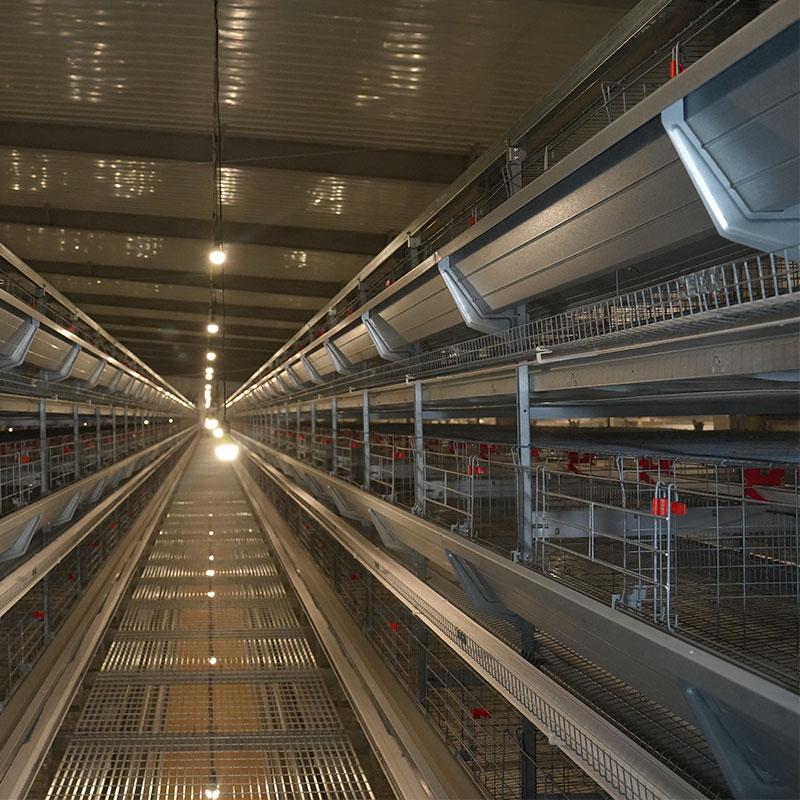
For decades, poultry farmers have navigated the delicate balance between bird density, labor costs, and animal welfare. The traditional ladder-style cage, while a step up from floor systems, often created operational bottlenecks and limited a farmer’s ability to scale efficiently. The introduction of the H-Type Layer Chicken Cage system represents a fundamental shift in layer housing, moving from a static structure to a dynamic, integrated production unit. This system is not merely a cage; it is the central nervous system of a modern egg production facility, where architecture, mechanics, and animal science converge to create a streamlined environment.
The defining visual characteristic of the H-Type system is its multi-tiered, staggered configuration. Unlike older battery cages that stack directly on top of one another, the H-Type design arranges tiers in a stepped formation. Picture a staircase, where each step is a fully functional cage row. This "H" frame structure provides a critical advantage: unobstructed access. A farmer walking the central aisle can see directly into every cage on every level without crouching or straining. This simple architectural change transforms daily bird inspection from a choreographic feat into a straightforward walk. Manure, instead of falling from an upper tier onto a lower one, drops through the open space between the staggered tiers onto a central manure belt or into a deep pit below, drastically improving hygiene and air quality within the house.
The Core Components: An Integrated Production Line
Understanding the H-Type system requires looking at it not as a collection of parts, but as a single, synchronized machine. Its efficiency is derived from the seamless interaction of its automated subsystems.
1. The Automated Feeding System: Precision and Consistency
At the heart of any successful layer operation is nutrition. The H-Type system replaces manual scooping and unpredictable scatter feeding with a precision-engineered chain or auger system. Imagine a continuous loop of chain, running along a trough in front of each cage row, from the youngest pullets to the end-of-lay hens. This chain is loaded at a central feed bin, often located outside the poultry house. At programmed intervals, the chain starts its journey, carrying a consistent, fresh supply of feed past every bird.
The benefit here is twofold: elimination of feed competition and nutritional consistency. In a manual system, aggressive birds can monopolize feed points, leaving shyer flock mates undernourished. The continuous trough of the automated system ensures every hen has equal access at all times. Furthermore, because the feed is moved and distributed mechanically, it does not segregate; the fine particles and larger components of the ration remain mixed, ensuring each peck delivers the intended balance of nutrients, vitamins, and minerals. This consistency is reflected in more uniform egg size, stronger shell quality, and a more stable flock health profile.
2. The Egg Collection System: Gentle Handling for Premium Quality
The moment an egg is laid is its most vulnerable. In non-automated systems, eggs are handled multiple times, increasing the risk of hairline cracks, checks, and bacterial contamination. The H-Type system addresses this with a gentle, hands-off approach from the moment the egg rolls out of the cage.
Each cage floor is sloped, encouraging the egg to roll gently onto a soft, rubberized collection belt that runs the entire length of the tier. These belts operate at set times, slowly and smoothly transporting the eggs to one end of the house. Upon arrival, they are typically transferred to a central cross-conveyor that carries them directly to the egg grading and packing room. This process minimizes collisions and jostling. The reduction in manual handling not only preserves the integrity of the shell but also drastically cuts labor costs. What was once a task requiring several workers spending hours each day collecting eggs is now a process managed by the push of a button, with the eggs arriving clean and ready for processing.
3. The Manure Removal System: A Foundation for Health
Manure management is arguably the most critical determinant of indoor air quality and bird health. Wet, accumulated manure releases ammonia, which irritates the birds' respiratory tracts, predisposing them to infections like bronchitis and E. coli. It also attracts flies and promotes the growth of pathogens.
The H-Type system typically employs one of two primary manure management strategies. The first is the manure belt system, where a continuous, durable plastic belt runs beneath each tier. Manure drops onto this belt, which is then activated periodically—often once every few days—to transport the waste out of the poultry house to a centralized collection point. This method keeps the house exceptionally dry and minimizes ammonia levels.
The second common method is the deep pit system, where the staggered tiers allow manure to fall into a large, ventilated pit several meters deep beneath the entire house. This manure is allowed to dry and decompose over the flock’s production cycle, to be removed entirely after the birds are depopulated. Both systems create a drier environment. For a farmer, this translates to healthier birds, reduced reliance on ventilation and heating (as ammonia removal is less demanding), and lower veterinary costs. The air inside the house is fresher, which is better for both the birds and the farm staff.
4. The Watering System: Clean Water on Demand
Access to clean water is non-negotiable. H-Type cages are equipped with nipple drinking systems. A hen must activate a pin with her beak to release a drop of water. This closed-system design is a vast improvement over open troughs or cup drinkers. Because the water is enclosed within a pipe until the moment of consumption, it is protected from dust, feed, and fecal contamination. This dramatically reduces the spread of waterborne diseases. The system is connected to a central water line with pressure regulators and filters, ensuring that every bird, on every tier, receives the same clean, fresh water. A farmer can monitor water consumption as a key early-warning health indicator; a sudden drop in water intake often signals a problem before it becomes visible in the flock.
Economic and Operational Implications for the Farmer
Adopting an H-Type system is a significant capital investment. The justification for this investment lies in the long-term operational savings and enhanced revenue potential.
Labor efficiency undergoes a radical transformation. Tasks that once consumed hours of manual work—feeding, egg collection, and manure cleaning—are now automated. This allows a farm manager to reallocate human resources to higher-value activities such as detailed flock monitoring, biosecurity enforcement, and equipment maintenance. One person can effectively manage a flock of tens of thousands of layers, a ratio that was unimaginable with traditional systems.
Bird density is increased, but in a controlled manner. The vertical design of the H-Type system allows a farmer to house more birds within the same building footprint without increasing the stocking density per square foot of cage floor. This improves the return on investment for the poultry house itself. However, this must be managed with careful attention to the welfare codes and the specific cage dimensions to avoid overcrowding.
The improvements in egg quality directly impact profitability. With a significant reduction in cracked and dirty eggs, the proportion of Grade A eggs suitable for the premium retail market increases. This can mean the difference between selling a dozen eggs for a top price and selling them for breaking stock or processing at a fraction of the cost. The consistent feed delivery promotes flock uniformity, leading to a more standardized egg product, which is highly valued by large-scale buyers and distributors.

Optimizing the System for Flock Performance
Installing the hardware is only the first step. Maximizing the return on an H-Type system requires fine-tuning the management practices to work in harmony with the technology.
Lighting programs must be uniform across all tiers. With birds living at different heights, it is crucial to ensure that the light intensity and duration are consistent for every cage row. Supplemental lights may be needed at the lower tiers to prevent variations in laying cycles. A hen that receives less light may come into lay later or have a disrupted production rhythm.
Ventilation strategy must account for the stratified environment. Warm air and ammonia rise. Therefore, the air quality at the top tier can be different from that at the bottom. A well-designed ventilation system will create a uniform airspeed and temperature throughout the house, preventing pockets of stale, moist air from forming around the lower tiers. This often involves a combination of side-wall inlets and ridge fans to create a uniform tunnel effect.
Training the birds to use the nipple drinkers is a simple but vital step when introducing new pullets to the system. This usually involves manually triggering the nipples to show the birds the source of water and ensuring they are bright and easily visible.
Regular, proactive maintenance is the linchpin of reliability. The automated systems are mechanical and require upkeep. A failed manure belt bearing or a kink in the egg collection belt can disrupt the entire operation. A disciplined schedule for lubricating chains, checking belt tension, cleaning water filters, and inspecting electrical components is not optional; it is essential to prevent costly downtime.

The transition to an H-Type Layer Chicken Cage system is a strategic decision that moves a farm from a labor-intensive model to a technology-driven one. It represents an investment in consistency, animal welfare, and operational control. By integrating feeding, watering, egg collection, and manure management into a single, coordinated process, it allows farmers to manage larger flocks with greater precision and fewer resources. The result is a more predictable, profitable, and sustainable business, capable of meeting the rigorous demands of modern egg production.
1. Drinking system include the water pipes, water pressure adjuster, drinking nipples, Waterline front-end device, dosing system etc, choose them according to customer's needs.
2. High-quality water drinking pipes, pressure regulating valves and water drinking nipples can effectively prevent the water leakage. Drinking system adopt the closed piping system, which can minimize the water pollution.
3. 360-degree drinking nipples provide adequate drinking water for poultry at all stages.
4. The automatic drinking water system mainly adopts the steel ball drinking nipple. lt uses imported high-grad stainless steel, POM resin, and APS engineering material, which is wearing resistant, and the durability can be used for long time.



1. Automatic feeding machine can be chosen between gantry and ladder feeding machine. Gantry type feeding machine is a relatively economical and practical machine with simple operation, remote control walking character, easy to manage.
2. Mechanical transmission device running smoothly, low noise, long service life.
3. With the use of automatic control, the feeding system can adjust the amount of material.
4. Feeding with arched structure, high carrying capacity, not easily deformed.
5. Saving man power, saving feed, greatly improving the efficiency of Large-scale farming.
6. The walking speed of gantry feeding machine is 9--12 m/min.




1. Manure removing system included scraper type and conveyor belt type, Which can reduce the labor intensity and labor cost, keep the chicken shed dry and clean.
2. A type chicken cage can use scraper type or conveyor belt type.


3. The scraper type is suitable for A type cages, which can clean two or three rows. For the starters, this type is a good choice. lt can not only save some labor cost, but also save some investment in the whole project. The cleaning speed is 6-10 meters per minute.
4. Conveyor belt type is more suitable for large scale farming. The manure removing belt we use is high quality PP material (polypropylene). The walking speed is 2-4 meters per minute.



High Quality Pellets Made by Mobile Pellet Machine
1. It has professional designed angle of the blade. After the dynamic balance test one by one, the blade can operate smoothly.
2. The air volume is consistent in the whole life of the fan. Bearings has advantage of high strength, low noise, durable and so on.
1. The cooling pads uses high-quality wet curtain paper and adopts space cross-linking technology, which has the advantages of high water absorption, high water resistance, anti-toxicity and long service life.
2. The cooling efficiency is over 80%, without surfactant, natural water absorption, fast diffusion speed and long-lasting effect.
3. The product does not contain phenol and other chemical substances that are easy to cause skin allergies. It is non-toxic and harmless to the human body and chicken when installed and used. It is green, safe, energy-saving, environmentally friendly, economical, and easy to install.
4. The frame aluminum alloy has high strength, good corrosion resistance, durability and beautiful appearance.
5. Use a special filter for the cooling pad at the upper water to ensure clean water quality and support efficient water circulation components.
6. Combined with a negative pressure fan, it can effectively lower the indoor temperature.
The window is made of special selected high-quality engineering plastic, with high strength and long service life, together with superior anti-aging and anti-UV performance.
Function: Ventilation of the chicken house, usually used in the winter.
This system can adjust the wind speed and direction, thus the cold air will not reach chicken directly , which can effectively prevent the phenomenon of cold stress in chicken.
Environmental control system equipment is suitable for large-scale and intensive farming. According to customer requirements, we can provide various types of smart poultry equipment.
1. Our poultry management system is a modular system that manages all aspects of the chicken house, such as climate, temperature, humidity, ammonia, feeding, feed weighing, lighting and ventilation systems, and can monitor the situation of the chicken house in real time through a computer and mobile phone.
2. The management computer is the heart of the poultry farm, allowing you to easily monitor the entire poultry farm.

 WeChat:+8617838608255