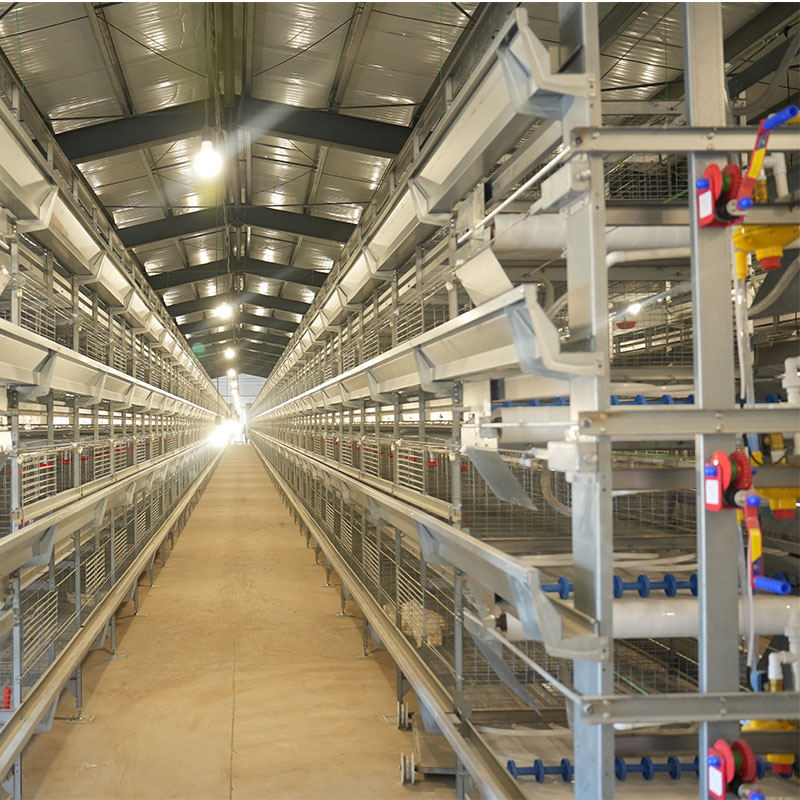
The financial commitment required for modern broiler cage systems remains one of the most significant considerations for any poultry operation looking to scale or upgrade. The question of price is not a simple one; it is a complex calculation that intertwines hardware costs with long-term operational performance. A farmer who only looks at the initial invoice price per cage unit is seeing a fraction of the picture. The true cost is measured over the lifespan of the system, factoring in bird performance, labor efficiency, and resource management.
To understand the investment, we must first dissect the components of a broiler cage system. Unlike the open-floor barns of the past, these are integrated structures designed for high-density, controlled-environment production.
The primary expense is the cage battery itself. This refers to the stacked tiers of cages, typically arranged in two to six levels. A three-tier system will naturally carry a higher material cost than a two-tier but offers a greater bird capacity within the same building footprint. The material used for the cage frame and mesh is a major price differentiator. Basic, hot-dipped galvanized steel is the industry standard, providing a solid balance of rust resistance and cost. A step up involves materials like zinc-aluminum alloy coating, which offers a significantly longer lifespan, especially in humid climates where ammonia corrosion can quickly degrade lesser materials. The gauge, or thickness, of the wire is another factor. A heavier 4-gauge wire in the flooring provides better support for heavier broilers and will resist sagging over time compared to a lighter 5-gauge wire, but it adds to the initial material and shipping weight.
The flooring system is not just wire; it is a critical interface between the bird and the manure. The design here directly impacts bird health and labor. Traditional welded wire flooring is cost-effective. A more advanced option is plastic-coated flooring. While more expensive upfront, the plastic coating reduces foot pad lesions and breast blisters, which can downgrade carcass value at processing. Some systems incorporate a plastic slat floor, which is even gentler on the birds but represents a higher tier of investment.

Below the cages lies the manure management system. This is where operational costs are truly defined. The simplest and cheapest option is a manure belt system. A continuous canvas or polymer belt runs beneath each tier of cages, collecting droppings. A farmer sets a timer for the belt to advance once or twice daily, moving the manure to one end of the house into a cross conveyor or a collection trolley. The cost escalates with the level of automation. A fully automated system that ties the manure belts to a central conveyor, which then loads directly into a spreader truck outside the barn, eliminates daily manual labor. The initial investment is substantial, but it replaces hours of physical work each day and provides a more consistent manure handling routine.
The feeding and drinking lines are the circulatory system of the operation. A basic pan-and-chain feeding system, where a metal chain drags feed along a trough to fill hanging pans, is a proven and relatively inexpensive technology. The modern alternative is the auger-fed system. Here, a spiral auger within a tube precisely delivers feed from a central hopper to each cage row. Auger systems are gentler on feed, reducing waste and degradation, and allow for more precise portion control, but they come at a premium. Similarly, nipple drinking systems are standard. The cost variance comes in the quality of the stainless-steel nipples, the water pressure regulators, and the filtration systems. A cheap nipple may leak or fail to trigger, leading to water wastage and wet litter issues even in cages, while a high-quality system ensures every bird has consistent access to clean water.
The price of a system is also deeply affected by the degree of integration and control. A basic cage system is a piece of hardware. A modern, high-end system is a networked piece of technology. It includes sensors that monitor feed levels in the hoppers, water flow rates, and interior environmental conditions. This data is fed to a central controller that can automatically adjust feeder run times, trigger alarms for low water pressure, or integrate with the barn’s ventilation and heating systems. This level of automation and data collection is a significant added cost but provides the tools for precision management, potentially optimizing feed conversion ratios and catching problems before they impact the flock.
So, what does this translate to in actual financial terms? Providing a single price is misleading, as it depends entirely on configuration, quality, and scale. However, we can establish a realistic framework.
A basic, no-frills broiler cage system from a regional manufacturer, featuring galvanized steel, two tiers, manual manure belts, and a chain feeding system, might fall in a range that equates to $15 to $25 per bird capacity. This means outfitting a house for 20,000 birds could see a cage system investment between $300,000 and $500,000. This is typically the entry point for smaller operations prioritizing upfront cost.
The mid-range market, which most large-scale commercial farms operate within, features heavier-gauge, corrosion-resistant materials, three or four tiers, automated manure belts with cross conveyors, and auger feeding systems. Here, the investment per bird place rises considerably, often landing between $30 and $50. For that same 20,000-bird house, the total now ranges from $600,000 to $1,000,000. This tier offers a robust balance of durability and labor savings.
At the premium end, systems from international manufacturers with the latest automation, six-tier stacks, plastic-coated flooring, integrated climate and data management, and top-tier materials can push the cost per bird place to $60 or higher. The investment for a large house can easily exceed $1.2 million. This is for operations where maximizing output per square foot and minimizing labor costs are the primary drivers, and the capital is available to achieve it.
These figures cover the cage system itself but are only part of the total project cost. They do not include the essential peripherals: the climate control computers, the ventilation fans and inlets, the heating systems (often radiant tubes or brooders), the insulation of the barn, and the electrical infrastructure to power it all. A common rule of thumb is that the cage system itself will account for 60-70% of the total equipment cost for a new build-out. The building structure is another major cost entirely.
Therefore, the decision-making process must move beyond price per unit. It must be a calculated assessment of Return on Investment (ROI). A cheaper system that requires two hours of manual labor daily to advance manure belts has a hidden, recurring cost. Calculate the wage of that worker over five years and add it to the initial price of the system. Compare that to the higher upfront cost of a fully automated manure system that requires only weekly maintenance checks.
The impact on feed conversion ratio (FCR) is perhaps the most powerful financial lever. A well-designed auger system that minimizes feed spillage and selective feeding, combined with a cage environment that reduces bird activity (and thus energy expenditure), can shave points off the FCR. For a 20,000-bird flock, an improvement of just 0.05 in FCR can save thousands of dollars in feed costs per flock. Over several flocks, the savings can outright eclipse the price difference between a basic and a premium feeding system.

Bird health and performance metrics directly translate to the paycheck. Reduced mortality, improved uniformity (more birds hitting the target weight window), and fewer condemnations at the plant due to better foot pad health all contribute to revenue. A system that improves livability by 1% might pay for its upgraded features within a few production cycles.
Finally, consider durability and service. A system with a 10-year warranty on corrosion and a network of responsive local technicians may have a higher sticker price than a system with a 5-year warranty and distant support. A single breakdown during a grow-out cycle that isn’t resolved quickly can devastate performance. The value of reliability and strong service support is a critical, though intangible, part of the cost equation.
Selecting a broiler cage system is a strategic decision that will define an operation’s efficiency and profitability for a decade or more. The initial purchase price is merely the entry ticket. The real cost is revealed in the daily grind of managing the flock: the hours spent on manual tasks, the tonnage of feed converted to meat, the health of the birds sent to processing, and the resilience of the equipment against the harsh environment of a poultry house. The most economical system is not the one with the lowest price tag, but the one that, over its entire operational life, delivers the lowest cost per kilogram of meat produced.
1. Drinking system include the water pipes, water pressure adjuster, drinking nipples, Waterline front-end device, dosing system etc, choose them according to customer's needs.
2. High-quality water drinking pipes, pressure regulating valves and water drinking nipples can effectively prevent the water leakage. Drinking system adopt the closed piping system, which can minimize the water pollution.
3. 360-degree drinking nipples provide adequate drinking water for poultry at all stages.
4. The automatic drinking water system mainly adopts the steel ball drinking nipple. lt uses imported high-grad stainless steel, POM resin, and APS engineering material, which is wearing resistant, and the durability can be used for long time.



1. Automatic feeding machine can be chosen between gantry and ladder feeding machine. Gantry type feeding machine is a relatively economical and practical machine with simple operation, remote control walking character, easy to manage.
2. Mechanical transmission device running smoothly, low noise, long service life.
3. With the use of automatic control, the feeding system can adjust the amount of material.
4. Feeding with arched structure, high carrying capacity, not easily deformed.
5. Saving man power, saving feed, greatly improving the efficiency of Large-scale farming.
6. The walking speed of gantry feeding machine is 9--12 m/min.




1. Manure removing system included scraper type and conveyor belt type, Which can reduce the labor intensity and labor cost, keep the chicken shed dry and clean.
2. A type chicken cage can use scraper type or conveyor belt type.


3. The scraper type is suitable for A type cages, which can clean two or three rows. For the starters, this type is a good choice. lt can not only save some labor cost, but also save some investment in the whole project. The cleaning speed is 6-10 meters per minute.
4. Conveyor belt type is more suitable for large scale farming. The manure removing belt we use is high quality PP material (polypropylene). The walking speed is 2-4 meters per minute.



High Quality Pellets Made by Mobile Pellet Machine
1. It has professional designed angle of the blade. After the dynamic balance test one by one, the blade can operate smoothly.
2. The air volume is consistent in the whole life of the fan. Bearings has advantage of high strength, low noise, durable and so on.
1. The cooling pads uses high-quality wet curtain paper and adopts space cross-linking technology, which has the advantages of high water absorption, high water resistance, anti-toxicity and long service life.
2. The cooling efficiency is over 80%, without surfactant, natural water absorption, fast diffusion speed and long-lasting effect.
3. The product does not contain phenol and other chemical substances that are easy to cause skin allergies. It is non-toxic and harmless to the human body and chicken when installed and used. It is green, safe, energy-saving, environmentally friendly, economical, and easy to install.
4. The frame aluminum alloy has high strength, good corrosion resistance, durability and beautiful appearance.
5. Use a special filter for the cooling pad at the upper water to ensure clean water quality and support efficient water circulation components.
6. Combined with a negative pressure fan, it can effectively lower the indoor temperature.
The window is made of special selected high-quality engineering plastic, with high strength and long service life, together with superior anti-aging and anti-UV performance.
Function: Ventilation of the chicken house, usually used in the winter.
This system can adjust the wind speed and direction, thus the cold air will not reach chicken directly , which can effectively prevent the phenomenon of cold stress in chicken.
Environmental control system equipment is suitable for large-scale and intensive farming. According to customer requirements, we can provide various types of smart poultry equipment.
1. Our poultry management system is a modular system that manages all aspects of the chicken house, such as climate, temperature, humidity, ammonia, feeding, feed weighing, lighting and ventilation systems, and can monitor the situation of the chicken house in real time through a computer and mobile phone.
2. The management computer is the heart of the poultry farm, allowing you to easily monitor the entire poultry farm.

 WeChat:+8617838608255