
The financial commitment to a layer cage system represents one of the most significant capital expenditures a poultry farmer will make. The question of cost is not a simple one, as the final price tag is a composite of cage type, material quality, automation level, and a host of ancillary expenses that are often overlooked in initial budgeting. Understanding these variables is crucial for making an investment that aligns with both operational scale and long-term profitability.
The spectrum of cage systems available ranges from basic manual units to fully integrated, computer-controlled environments. The initial purchase price is merely the entry point; the true cost must be evaluated over the productive lifespan of the system, factoring in labor savings, bird performance, and durability.
The Core Cage Structure: A Question of Tier and Material
The most visible cost differentiator is the configuration of the cages themselves, typically categorized by the number of vertical tiers.
Single-Tier (A-Type or Flat-Deck) Cages
These systems arrange cages on a single level, usually at a height that allows workers to comfortably access all birds without stooping or climbing. While this design requires more floor space per bird, it offers distinct advantages that influence their value.
The environment in a single-tier system is often superior. With no cages above them, each row of birds benefits from uniform air quality, temperature, and light intensity. There’s no stratification of heat or accumulation of ammonia from lower tiers. This can directly impact hen health and consistent lay rates. For a farmer dealing with respiratory issues in a crowded, multi-tier house, the single-tier option can reduce veterinary costs and mortality rates. The ease of access also translates to faster, less strenuous bird inspection, vaccination, and removal of spent hens. The labor time saved in daily management and the potential for improved bird welfare leading to better production can offset the higher initial space cost. These systems are frequently priced between $25 and $45 per bird space, reflecting their premium positioning for higher-welfare or niche market production.
Multi-Tier (Battery) Cages
The workhorses of the commercial egg industry, multi-tier systems maximize bird density within a given building footprint. Common configurations are 3-tier, 4-tier, and the increasingly popular 6-tier and 8-tier high-rise systems.
A 4-tier system is a common benchmark. It represents a balance between density and manageability. A worker can typically reach into the second-tier cages from the floor and the third and fourth tiers from a raised walkway or platform. The cost efficiency is clear: you are housing four layers of birds in the space of one. This density drastically reduces the cost per bird for the building itself (less roofing, less walling, less foundation).
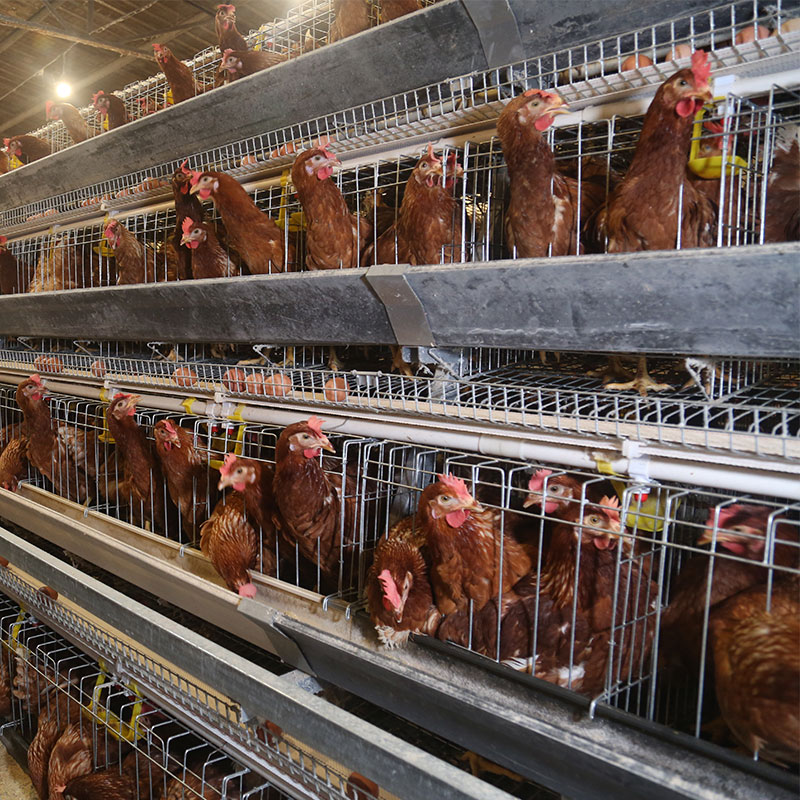
The challenge, and a hidden cost, is environmental management. With multiple tiers, the house requires a more sophisticated ventilation system. Stale, moist air laden with dust and dander from the lower tiers must be actively exhausted, and fresh air uniformly distributed to prevent hot spots and air quality issues at the top. A farmer might find that a 6-tier system requires a $20,000 ventilation upgrade compared to a 4-tier system in the same building, a cost that must be amortized over the bird spaces. Multi-tier systems range widely from $15 to $30 per bird space, with price escalating with tier height due to the need for stronger materials and more complex manure belts.
Material and Construction Quality
The gauge of the galvanized steel wire is a primary determinant of longevity and cost. A flimsy, thin-gauge wire will sag under the weight of the birds over time, making egg collection uneven and potentially damaging eggs. It is also more prone to corrosion from ammonia and moisture, leading to premature failure. A high-quality, heavy-gauge wire with a thick zinc coating might cost 20% more upfront but can easily last for 15 years instead of 8, making it the more economical choice over the long term.
The design of the cage floor—the wire mesh the hens walk on—is another critical factor. A poorly designed floor can lead to foot lesions and bumblefoot, causing pain for the bird and creating a point of infection. A high-quality floor will have a specific slope to allow eggs to roll away gently without cracking and a wire geometry that provides support without injuring feet. The cost of addressing flock health issues stemming from inferior equipment far exceeds the marginal savings on cheaper cages.
The Automation Gradient: From Manual Labor to Precision Management
The cost of the physical cages is often less than half the story. The level of automation integrated into the system is where the largest financial divergence occurs and where the most significant operational savings are realized.
Manual Systems
At the most basic level, a manual system consists of the cages, simple feeders, and nipple drinkers. Everything else is done by hand. Workers must collect eggs from each cage daily, a time-consuming process that increases labor costs and the risk of egg damage through handling. Manure accumulates in pits below the cages and must be cleaned out periodically, a physically demanding and unpleasant task that disrupts the flock.
The apparent low cost of a manual system is deceptive. The constant drain on labor hours creates a persistent operational expense. For a 10,000-bird layer house, egg collection alone could be a 3-4 hour daily task for one worker. When calculating the total cost of ownership, the salary and benefits for that labor over five years will almost certainly surpass the additional capital needed for a basic automated system. Manual systems are increasingly rare outside of very small-scale operations where labor is family-based and readily available.
Semi-Automated Systems
This is the most common entry point for serious commercial farmers. A semi-automated system typically includes:
Automatic Feeders: A chain or auger system that delivers feed from a central bin to a trough running the length of each row. This ensures every bird has access to fresh feed simultaneously and eliminates the labor of manual feeding.
Automatic Egg Collection: Belts run beneath each tier of cages. Eggs roll out of the cage onto these belts, which are activated once or twice daily to transport all eggs to a central collection point. This reduces labor to a single person managing the collection process and drastically reduces egg breakage.
Manure Belts: Rubber or plastic belts are installed under each tier to catch droppings. These belts are activated periodically (e.g., once every 2-3 days) to carry the manure to a cross-conveyor that deposits it into a trailer or a pile outside the house. This eliminates the need for pit scraping and creates a drier, healthier environment.
The jump from manual to semi-automated can add $8 to $15 per bird space to the system cost. However, the return on investment is often rapid, calculated in months rather than years, due to the dramatic reduction in required labor.
Fully Automated Systems
This is the pinnacle of layer housing technology, representing the highest initial investment but the lowest operational cost and highest level of control. Beyond semi-automated features, a full system includes:
Climate Control: Computerized systems manage fans, heaters, cooling pads, and inlet curtains based on real-time temperature and humidity sensors, maintaining the optimal environment 24/7 without human intervention.
Centralized Egg Handling: Eggs from the collection belts are automatically conveyed to a central egg room where they are washed, graded, and sorted by weight by machinery. This ready-to-pack output eliminates a massive amount of post-collection processing labor.
Advanced Manure Drying: Systems often include in-house manure dryers that reduce the volume and weight of waste by removing moisture, turning it into a stable, valuable fertilizer product that is easier to store and sell.
Monitoring Systems: Integrated sensors track feed consumption, water usage, egg production per row, and environmental conditions. This data is accessible remotely, allowing a manager to receive alerts for problems like a water line failure or a drop in egg yield and to respond immediately.
A fully automated system for a high-rise house can command $40 to $60 or more per bird space. The justification for this investment is operational scale and reliability. For a operation with 100,000 hens, the labor savings alone can justify the automation. The data collected allows for precision management, fine-tuning feed formulas and environmental settings to push flock performance to its genetic potential.
The Hidden and Ancillary Costs

A budget that only accounts for the cage and automation system is destined for overspending. Several critical ancillary expenses must be factored in.
Delivery and Installation: These systems are not plug-and-play. They arrive as countless components—beams, wires, belts, motors, and sensors—that require skilled technicians to assemble. Installation costs can represent 10-20% of the equipment cost. For a large project, farmers may need to hire a specialized construction crew and crane operators to erect high-rise systems.
Building Modifications: The existing poultry house may require significant reinforcement. The weight of a 6-tier system, fully stocked with birds, feed, and equipment, is immense. Floor foundations may need to be strengthened, and roof trusses may need additional support to handle the load of suspended feeders and ventilation systems. Electrical systems must be upgraded to power dozens of motors, controllers, and computers. These structural and infrastructural costs can easily run into tens of thousands of dollars.
Training: A sophisticated automated system is only as good as the people running it. Staff must be trained not only on daily operation but also on basic troubleshooting. Understanding how to clear a jammed egg belt or reset a motor controller prevents minor issues from causing major downtime. Vendor-provided training is essential and is sometimes an added cost.
Maintenance and Spares: Conveyor belts wear out, motors burn out, and sensors fail. A prudent farmer will budget 2-5% of the initial system cost annually for maintenance and keep a inventory of critical spare parts (drive units, circuit boards, belts) to avoid production halts.
Navigating the Purchase: A Practical Approach
Determining the right system is a function of business size, available labor, and long-term strategy.
For a small-scale farmer with under 5,000 birds and reliable, low-cost labor, a robust 3-tier or 4-tier semi-automated system may offer the best balance. The focus should be on quality materials to ensure durability, even if it means a slightly higher per-bird cost.
For a mid-sized farm (20,000-50,000 birds), the economics of automation become compelling. A 4-tier or 6-tier semi-automated system with good environmental controls is typically the standard. The investment is justified by the significant reduction in labor costs and improvements in bird management.
For large commercial operations (100,000+ birds), the calculation shifts entirely toward maximizing efficiency and minimizing variable costs. A fully automated, high-rise (6 to 8 tier) system is the norm. The high capital outlay is justified by the incredibly low cost per egg produced, driven by minimal labor, optimal feed conversion, and high throughput. The decision is strategic, aimed at securing a competitive advantage in a high-volume, low-margin market.
The final price is never just a number on a quote. It is a complex equation balancing capital expenditure against years of operational expense, bird welfare, and management ease. The most cost-effective cage system is the one that aligns precisely with the scale, resources, and ambitions of the farm, turning a substantial investment into a engine for sustained profitability.
1. Drinking system include the water pipes, water pressure adjuster, drinking nipples, Waterline front-end device, dosing system etc, choose them according to customer's needs.
2. High-quality water drinking pipes, pressure regulating valves and water drinking nipples can effectively prevent the water leakage. Drinking system adopt the closed piping system, which can minimize the water pollution.
3. 360-degree drinking nipples provide adequate drinking water for poultry at all stages.
4. The automatic drinking water system mainly adopts the steel ball drinking nipple. lt uses imported high-grad stainless steel, POM resin, and APS engineering material, which is wearing resistant, and the durability can be used for long time.



1. Automatic feeding machine can be chosen between gantry and ladder feeding machine. Gantry type feeding machine is a relatively economical and practical machine with simple operation, remote control walking character, easy to manage.
2. Mechanical transmission device running smoothly, low noise, long service life.
3. With the use of automatic control, the feeding system can adjust the amount of material.
4. Feeding with arched structure, high carrying capacity, not easily deformed.
5. Saving man power, saving feed, greatly improving the efficiency of Large-scale farming.
6. The walking speed of gantry feeding machine is 9--12 m/min.




1. Manure removing system included scraper type and conveyor belt type, Which can reduce the labor intensity and labor cost, keep the chicken shed dry and clean.
2. A type chicken cage can use scraper type or conveyor belt type.


3. The scraper type is suitable for A type cages, which can clean two or three rows. For the starters, this type is a good choice. lt can not only save some labor cost, but also save some investment in the whole project. The cleaning speed is 6-10 meters per minute.
4. Conveyor belt type is more suitable for large scale farming. The manure removing belt we use is high quality PP material (polypropylene). The walking speed is 2-4 meters per minute.



High Quality Pellets Made by Mobile Pellet Machine
1. It has professional designed angle of the blade. After the dynamic balance test one by one, the blade can operate smoothly.
2. The air volume is consistent in the whole life of the fan. Bearings has advantage of high strength, low noise, durable and so on.
1. The cooling pads uses high-quality wet curtain paper and adopts space cross-linking technology, which has the advantages of high water absorption, high water resistance, anti-toxicity and long service life.
2. The cooling efficiency is over 80%, without surfactant, natural water absorption, fast diffusion speed and long-lasting effect.
3. The product does not contain phenol and other chemical substances that are easy to cause skin allergies. It is non-toxic and harmless to the human body and chicken when installed and used. It is green, safe, energy-saving, environmentally friendly, economical, and easy to install.
4. The frame aluminum alloy has high strength, good corrosion resistance, durability and beautiful appearance.
5. Use a special filter for the cooling pad at the upper water to ensure clean water quality and support efficient water circulation components.
6. Combined with a negative pressure fan, it can effectively lower the indoor temperature.
The window is made of special selected high-quality engineering plastic, with high strength and long service life, together with superior anti-aging and anti-UV performance.
Function: Ventilation of the chicken house, usually used in the winter.
This system can adjust the wind speed and direction, thus the cold air will not reach chicken directly , which can effectively prevent the phenomenon of cold stress in chicken.
Environmental control system equipment is suitable for large-scale and intensive farming. According to customer requirements, we can provide various types of smart poultry equipment.
1. Our poultry management system is a modular system that manages all aspects of the chicken house, such as climate, temperature, humidity, ammonia, feeding, feed weighing, lighting and ventilation systems, and can monitor the situation of the chicken house in real time through a computer and mobile phone.
2. The management computer is the heart of the poultry farm, allowing you to easily monitor the entire poultry farm.

 WeChat:+8617838608255