The Ultimate Guide to Choosing a Layer Cage Manufacturer: Quality, Design & ROI
For poultry farmers, the decision of where to source layer cages is one of the most critical investments in their operation's future. It’s not merely a purchase; it’s a longterm partnership that directly impacts bird welfare, egg production efficiency, operational costs, and ultimately, profitability. Choosing the right layer cage manufacturer is a complex process that balances engineering, animal science, and business acumen. This comprehensive guide is designed to equip you with the knowledge and framework to evaluate manufacturers beyond price, focusing on the factors that truly define quality, durability, and return on investment. We’ll delve into the core aspects of manufacturing excellence, from material science to system design, helping you make an informed decision that supports a sustainable and productive laying operation.
Modern layer cages are sophisticated systems engineered for optimal performance. A reputable manufacturer doesn't just weld metal; they integrate biology, behavior, and mechanics.
Cage Structure & Frame: The backbone of the system. Look for heavygauge, hotdipped galvanized steel for superior corrosion resistance and longevity.
Wire Mesh & Flooring: The flooring slope (typically 79 degrees), wire gauge, and coating are crucial for egg rollout efficiency and foot health (e.g., prevention of bumblefoot).
Feeding System: Options include trough lines or chain feeders. Precision in alignment and durability of components prevents feed waste and ensures uniform nutrition.
Watering System: Nipple drinkers are standard. The quality of nipples (stainless steel vs. plastic), water pressure regulation, and leakproof design are vital for bird hydration and dry manure.
Egg Collection System: Can be manual or automated (belt collection). Smooth belts with proper tensioning prevent egg cracks and losses.
Manure Removal System: Deep pit belts or scraper systems. Design must facilitate dry manure handling, reducing ammonia levels and improving barn environment.
The choice here impacts space utilization, bird density, and ventilation.
AFrame (StepCage): Traditional design offering good manure drying between tiers. Often preferred in environments with less mechanical ventilation.
HType (Vertical Stack): Maximizes bird density per square foot of floor space. Requires excellent climate control and automated systems for feeding, watering, and manure removal.
LType: A hybrid offering easier manure management than Htype while maintaining higher density than Aframe.
Moving beyond brochures requires due diligence. Use this checklist to assess potential partners.
A true manufacturer operates its own fabrication facilities. Ask for virtual or inperson tours.
Do they control the process from raw steel to finished product?
What is their level of automation in welding and galvanizing?
Is there a rigorous Quality Control (QC) protocol at each production stage?
This is the single biggest determinant of system lifespan.
Galvanization Process: Insist on hotdipped galvanized (HDG) steel after fabrication. This coats all welds and cut edges internally and externally. Electrogalvanized or pregalvanized sheet steel is inferior for cage systems.
Steel Gauge: Thicker gauge wire (lower number) in flooring supports bird weight better over time.
No two farms are identical. A toptier manufacturer offers tailored solutions.
Can they adapt row lengths, tier heights, and system layouts to your specific barn dimensions?
Do they provide detailed CAD layouts and flow simulations?
Do they engineer solutions for integration with your chosen climate control or feeding systems?
A responsible manufacturer designs with bird welfare in mind.
Are cages designed to meet or exceed relevant animal welfare codes (e.g., UEP Certified in the US, EU directives)?
Do designs allow for natural behaviors like perching? Is there adequate space per bird as defined by your market?
The best cages fail if supporting systems are poorly matched.
Does the manufacturer offer fully integrated systems (cage + feed + water + egg collection + manure belts) or just cages?
If providing integration, what is their experience with system synchronization?
The relationship begins after installation.
What is their warranty period? What does it cover?
Do they have a network of trained technicians or local agents for spare parts?
Can they provide detailed installation manuals and troubleshooting guides?
You need a partner that will be around in 1015 years for parts and support.
How long have they been in business?
Can they provide references from farms with installations that are 5+ years old?
What is their reputation in key markets?
Evaluating cost should be a multidecade calculation.
| Cost Factor | LowQuality/Cheap System | HighQuality/Investment System |
| : | : | : |
| Initial Purchase Price | Lower | Higher |
| Installation & Setup | May be complex due to poor fit/finish | Smoother due to precision engineering |
| Corrosion Resistance | Poor; may rust in 35 years | Excellent; lasts 1520+ years |
| System Downtime | Higher due to frequent repairs | Minimal; robust components |
| Egg Breakage Rate | Potentially higher due to poor design | Optimized for low breakage |
| Feed & Water Waste | Higher due to leaks/poor alignment | Minimized by precision |
| Spare Parts Cost/Availability | Difficult/expensive longterm | Readily available from stable co. |
| Resale Value | Very Low | Significant |
As shown above,the higher initial investment pays dividends through reduced operational headaches,lower replacement part costs,and sustained high production over the full lifespan of the equipment.
Selecting your layer cage manufacturer is a strategic decision that reverberates through every aspect of your farm's performance for years.The most successful producers look past the initial price tag to evaluate engineering integrity,material quality,and longterm partnership potential.They prioritize manufacturers who demonstrate deep expertise,a commitment to animal welfare,and robust aftersales support.Investing time now in thorough evaluation—using facility audits,material specifications,and reference checks—will lead you to a partner whose systems deliver not just eggs,but reliability,efficiency,and superior return on investment.Remember,in poultry farming,the foundation of productivity is literally built cage by cage;ensure yours is built by the best.
Q1: What's more important when choosing a manufacturer: price or quality?
While budget is always a constraint,focusing solely on price can be catastrophic.Quality determines longevity,system performance,bird welfare,and operating costs.A highquality system has a lower Total Cost of Ownership over its lifespan,making it more economical despite a higher initial price.
Q2: What's the difference between hotdipped galvanized (HDG) after fabrication vs.pregalvanized sheet steel?
This is crucial.HDG after fabrication immerses the fully welded cage structure in molten zinc.coating every surface,weld,and cut edge internally.This provides complete corrosion protection.Pregalvanized sheet is coated before bending/welding.exposing raw steel at cut edges which will rust first,making it unsuitable for humid,poultry house environments.
Q3: How many birds can typically fit into one commercial layer cage?
This varies significantly based on local animal welfare regulations.Capacities can range from 58 birds per cage unit in conventional designs down to smaller group sizes or even enriched colony systems designed for higher welfare standards.The manufacturer should design according to your target market's legal requirements.
Q4: Can I retrofit older poultry houses with new cage systems from any manufacturer?
Often,yes,but it requires careful planning.Reputable manufacturers offer customization services.They can adapt row lengths,tier heights,and equipment layouts to fit existing barn structures,maximizing your current infrastructure investment.
Q5: What kind of warranty should I expect from a reputable layer cage manufacturer?
Look for comprehensive warranties.A toptier manufacturer typically offers at least a 1015 year warranty against corrosion on hotdipped galvanized parts.Warranties on mechanical components like drive units,nipple drinkers,and egg belts may range from15 years.Read terms carefully regarding what's covered.
Q6: How do I assess if a manufacturer has strong experience(EEAT)?
Request case studies/project portfolios from similar sized farms.Check industry trade associations for member listings.Lookfor thirdparty certifications(ISO).Most importantly,speak directlyto past clients(references)and ask about postinstallation support,system durability,and problem resolution history.
Q7:WhatarethekeyquestionsIshouldaskwhenrequestingaquote?
Beyondpriceaskfor:Detailedmaterialspecifications(steelgalvanizationtype)CADlayoutofproposedsystemfullscopeofsupplylistcostbreakdownforinstallationvs.equipmentwarrantydocumentationtimelineforpartsdeliverysamplesoftechnicalmanuals.
Q8:Aretheredifferentcagedesignsforbrownvs.whiteegglayers?
Generally,the basic cage structure issimilar.Brown egg layers tendtobe slightlylargerbirds,sosome manufacturersmayrecommendadjustmentsincagedimensionsorfloorwiregaugetooptimizespaceandeggrollout.Specificbreedrequirements shouldalwaysbediscussedwiththemanufacturerandyourgeneticssupplier.
1. Drinking system include the water pipes, water pressure adjuster, drinking nipples, Waterline front-end device, dosing system etc, choose them according to customer's needs.
2. High-quality water drinking pipes, pressure regulating valves and water drinking nipples can effectively prevent the water leakage. Drinking system adopt the closed piping system, which can minimize the water pollution.
3. 360-degree drinking nipples provide adequate drinking water for poultry at all stages.
4. The automatic drinking water system mainly adopts the steel ball drinking nipple. lt uses imported high-grad stainless steel, POM resin, and APS engineering material, which is wearing resistant, and the durability can be used for long time.



1. Automatic feeding machine can be chosen between gantry and ladder feeding machine. Gantry type feeding machine is a relatively economical and practical machine with simple operation, remote control walking character, easy to manage.
2. Mechanical transmission device running smoothly, low noise, long service life.
3. With the use of automatic control, the feeding system can adjust the amount of material.
4. Feeding with arched structure, high carrying capacity, not easily deformed.
5. Saving man power, saving feed, greatly improving the efficiency of Large-scale farming.
6. The walking speed of gantry feeding machine is 9--12 m/min.




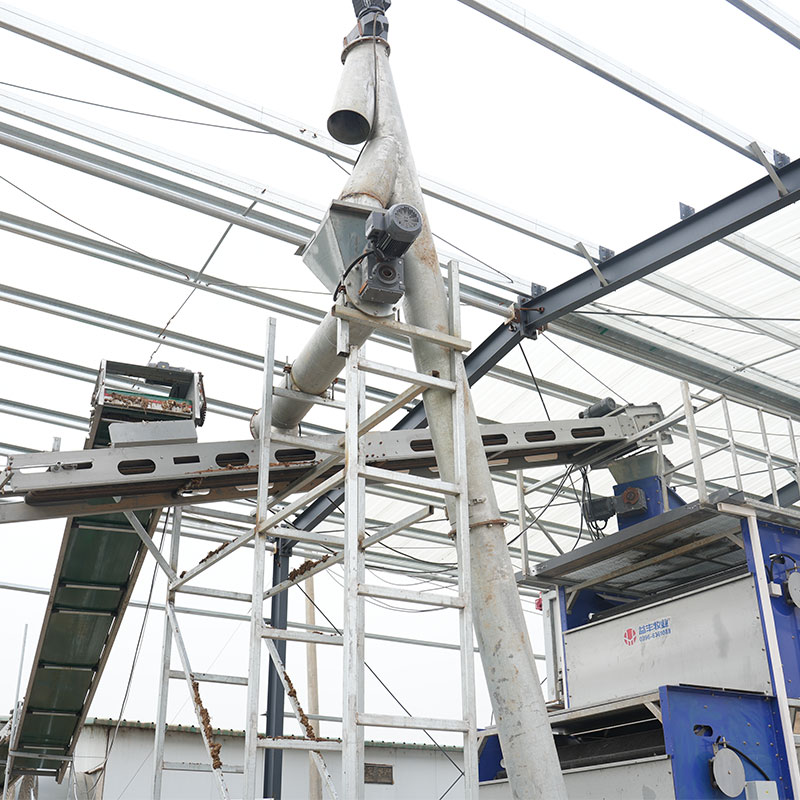
1. Manure removing system included scraper type and conveyor belt type, Which can reduce the labor intensity and labor cost, keep the chicken shed dry and clean.
2. A type chicken cage can use scraper type or conveyor belt type.


3. The scraper type is suitable for A type cages, which can clean two or three rows. For the starters, this type is a good choice. lt can not only save some labor cost, but also save some investment in the whole project. The cleaning speed is 6-10 meters per minute.
4. Conveyor belt type is more suitable for large scale farming. The manure removing belt we use is high quality PP material (polypropylene). The walking speed is 2-4 meters per minute.



High Quality Pellets Made by Mobile Pellet Machine
1. It has professional designed angle of the blade. After the dynamic balance test one by one, the blade can operate smoothly.
2. The air volume is consistent in the whole life of the fan. Bearings has advantage of high strength, low noise, durable and so on.
1. The cooling pads uses high-quality wet curtain paper and adopts space cross-linking technology, which has the advantages of high water absorption, high water resistance, anti-toxicity and long service life.
2. The cooling efficiency is over 80%, without surfactant, natural water absorption, fast diffusion speed and long-lasting effect.
3. The product does not contain phenol and other chemical substances that are easy to cause skin allergies. It is non-toxic and harmless to the human body and chicken when installed and used. It is green, safe, energy-saving, environmentally friendly, economical, and easy to install.
4. The frame aluminum alloy has high strength, good corrosion resistance, durability and beautiful appearance.
5. Use a special filter for the cooling pad at the upper water to ensure clean water quality and support efficient water circulation components.
6. Combined with a negative pressure fan, it can effectively lower the indoor temperature.
The window is made of special selected high-quality engineering plastic, with high strength and long service life, together with superior anti-aging and anti-UV performance.
Function: Ventilation of the chicken house, usually used in the winter.
This system can adjust the wind speed and direction, thus the cold air will not reach chicken directly , which can effectively prevent the phenomenon of cold stress in chicken.
Environmental control system equipment is suitable for large-scale and intensive farming. According to customer requirements, we can provide various types of smart poultry equipment.
1. Our poultry management system is a modular system that manages all aspects of the chicken house, such as climate, temperature, humidity, ammonia, feeding, feed weighing, lighting and ventilation systems, and can monitor the situation of the chicken house in real time through a computer and mobile phone.
2. The management computer is the heart of the poultry farm, allowing you to easily monitor the entire poultry farm.

 WeChat:+8617838608255