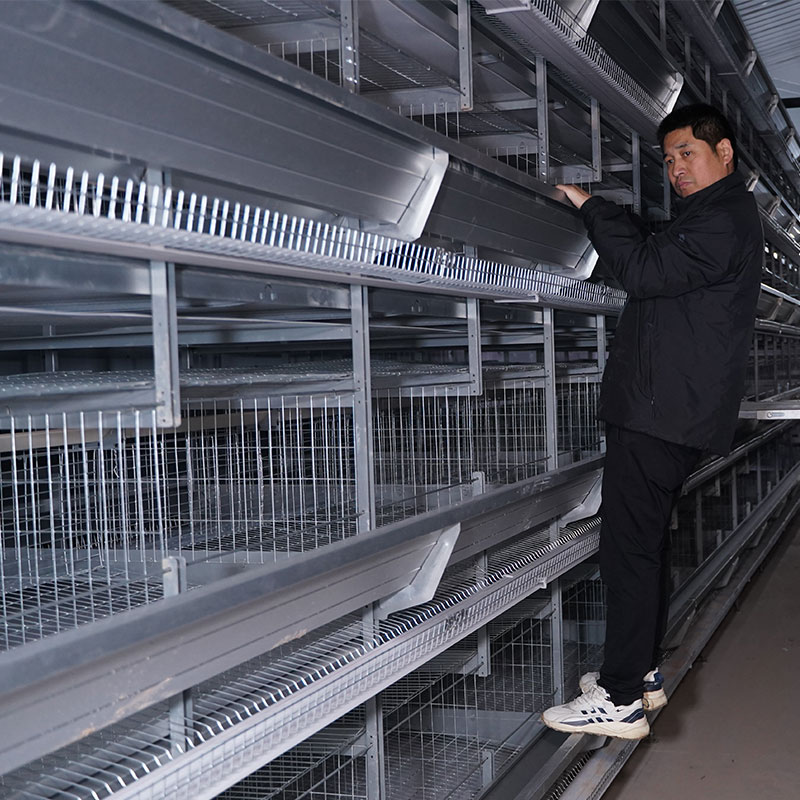
For poultry farmers watching feed costs climb while labor availability shrinks, the decision to transition to a full automatic layer cage system is no longer a question of if, but when. This technology moves beyond simply housing birds to creating an integrated environment where every element—feeding, watering, climate, and egg collection—works in concert to maximize flock performance and operational efficiency.
The core of the system is the cage battery itself, typically constructed from galvanized steel wire for longevity. These are not single cages but multi-tiered structures, often arranged in A-frame or stair-step configurations. Each tier contains a series of individual compartments. The slanted floor is a critical feature; it’s not solid, but made of welded mesh that allows manure to drop through. The gentle slope, often around 8 degrees, does the work of egg collection. As a hen lays an egg, it rolls away from her, out of the cage, and onto a conveyor belt running the length of the entire row. This immediate removal is the first step in preserving egg quality, preventing pecking, breakage, and contamination.
Beneath the cages, another conveyor belt, or a deep manure pit, manages waste. In systems with a belt, manure is scraped and transported to a central collection point at scheduled intervals, drastically reducing ammonia levels and improving air quality within the house. This is a stark contrast to manual scraping, which disrupts the flock and releases concentrated bursts of harmful gases.

The Engine of Automation: Feeding and Watering
The system’s pulse is its feeding line. A hopper, filled with a precisely formulated ration, feeds into a long chain or auger that runs through a trough in front of every cage. At programmed times, the chain starts, delivering a fresh, consistent supply of feed to all birds simultaneously. This eliminates the feed competition and stress seen in manual systems where dominant birds can monopolize resources. Farmers can adjust the frequency and duration of feeding cycles based on the flock's age and production stage. For instance, during peak lay, shorter, more frequent cycles ensure hens always have access to feed without it sitting and spoiling in the trough.
Watering is just as seamless. Nipple drinkers are positioned within each cage at the optimal height. When a hen is thirsty, she pecks at the pin, releasing a drop of water directly into her beak. This closed system prevents spillage and keeps water clean, a significant improvement over open troughs that can become contaminated with feed, dust, and droppings. The water line is connected to a central header with medicators or proportioners, allowing for effortless administration of vaccines, vitamins, or medications through the drinking water, ensuring the entire flock receives a uniform dose.
The Payoff: Egg Collection and Environmental Control
The egg collection conveyor is where the investment visibly pays off. The belts, often made of soft plastic to prevent cracking, gently transport eggs from the house to the central packing station. This can mean eggs moving to a room where workers can sort, grade, and pack them in a clean, controlled environment, separate from the dust and activity of the poultry house. The eggs arrive with cleaner shells and a significantly lower rate of hairline cracks compared to those gathered by hand from nest boxes.
Surrounding all this is the environmental control system. Modern layer houses are sealed environments. A computer, acting as the farm’s brain, continuously monitors temperature, humidity, and air quality. If the temperature rises above the set point, it triggers tunnel ventilation fans at one end of the house, pulling a breeze over the birds. At the same time, evaporative cooling pads at the air inlets activate, lowering the air temperature by several degrees as it enters. This is not just about comfort; heat stress can cause a hen to stop laying entirely. Conversely, in colder weather, the system manages minimum ventilation rates to exhaust moisture and ammonia without chilling the birds. This precise climate management is impossible to achieve consistently with manual curtain-sided houses, where weather fluctuations directly impact the internal environment and, consequently, production.
Justifying the Investment: A Financial Perspective
The capital outlay for a full automatic system is substantial. It’s not just the cost of the cages, but the supporting infrastructure: the feeding and egg collection systems, the climate computer, the ventilation fans, and often, reinforced electrical systems. However, the return is calculated over the lifespan of the equipment, typically 10-15 years, and is realized through several key channels.
Labor is the most obvious area of savings. A farm that required multiple workers for daily feeding, watering, and egg collection can now be managed by a single person overseeing the automated processes and performing essential flock checks. This not only reduces wage expenses but also insulates the farm from the growing challenge of finding reliable agricultural labor.
Feed conversion is another critical metric. Because the automated system provides measured rations with minimal waste, farmers often see a noticeable improvement in their feed conversion ratio—the amount of feed required to produce a dozen eggs. In a manual system, feed can be spilled, scattered, or spoiled. Here, every kilogram of feed is delivered directly to the bird, and the reduction in waste directly improves the bottom line.
Bird density is increased. By stacking cages vertically, a farmer can house significantly more birds on the same footprint of land. This maximizes the revenue potential of existing farm infrastructure. Furthermore, the controlled environment and reduced stress from automation contribute to lower mortality rates and more consistent egg production throughout the lay cycle. A hen that isn’t competing for feed or water, and that lives in a stable, comfortable climate, is a more productive hen.

Operational Realities and Flock Management
Transitioning to an automatic system changes daily routines. The farmer’s role evolves from manual laborer to systems manager and data analyst. Daily walks through the house are still essential, but the focus shifts. Instead of filling feeders, the farmer observes bird behavior, checking for uniform feed consumption across the house, listening for any signs of respiratory distress, and ensuring the nipple drinkers are functioning correctly. They monitor the control panel for any alarms and review data logs for temperature fluctuations.
Pullet rearing becomes more important than ever. Birds destined for an automatic system must be started on a similar system during the grow-out phase. They must learn from a young age to find feed on a moving chain and water from nipple drinkers. Placing a naïve flock into a complex automatic system can lead to disaster, as birds may not know how to eat or drink, leading to rapid dehydration and starvation.
Manure management is a daily consideration. For systems with manure belts, the scraping schedule must be maintained to prevent belt overload and ammonia buildup. In deep-pit systems, the accumulated manure is typically removed once or twice a year, a major operation that requires planning and equipment.
Power reliability is a paramount concern. These systems are entirely dependent on electricity. A prolonged power outage can stop ventilation, feeding, and watering, leading to catastrophic bird loss within hours. A backup generator is not an optional extra; it is a mandatory piece of insurance for the entire investment.
Weighing the Challenges
The primary barrier remains the high initial investment, which can be prohibitive for smaller operations without access to significant capital. The system’s complexity also demands a higher level of technical skill for troubleshooting. A broken chain feeder is not a simple fix; it requires understanding the drive motor, tensioners, and the chain itself. Farmers must either develop these mechanical and electrical skills or have a reliable service technician on call.
While animal welfare outcomes like lower mortality and better feather cover are often positive due to reduced stress and better hygiene, the system itself remains a subject of public and regulatory debate regarding space allowances and behavioral freedom. Modern designs are increasingly incorporating enrichments and providing more space per bird to address these concerns, but this remains a key consideration for farmers attuned to market expectations.
The shift to a full automatic layer cage system represents a fundamental modernization of a poultry enterprise. It is a capital-intensive, technologically sophisticated approach that trades manual labor for automated efficiency and direct operational control. For the farmer who masters its operation, the rewards are tangible: a significant reduction in recurring labor costs, improved feed efficiency, superior egg quality, and a more stable, productive flock. The system demands a new set of skills and a vigilant eye, but for those looking to scale their operation and secure its future in an increasingly competitive market, it provides a clear and calculated path forward.
1. Drinking system include the water pipes, water pressure adjuster, drinking nipples, Waterline front-end device, dosing system etc, choose them according to customer's needs.
2. High-quality water drinking pipes, pressure regulating valves and water drinking nipples can effectively prevent the water leakage. Drinking system adopt the closed piping system, which can minimize the water pollution.
3. 360-degree drinking nipples provide adequate drinking water for poultry at all stages.
4. The automatic drinking water system mainly adopts the steel ball drinking nipple. lt uses imported high-grad stainless steel, POM resin, and APS engineering material, which is wearing resistant, and the durability can be used for long time.



1. Automatic feeding machine can be chosen between gantry and ladder feeding machine. Gantry type feeding machine is a relatively economical and practical machine with simple operation, remote control walking character, easy to manage.
2. Mechanical transmission device running smoothly, low noise, long service life.
3. With the use of automatic control, the feeding system can adjust the amount of material.
4. Feeding with arched structure, high carrying capacity, not easily deformed.
5. Saving man power, saving feed, greatly improving the efficiency of Large-scale farming.
6. The walking speed of gantry feeding machine is 9--12 m/min.




1. Manure removing system included scraper type and conveyor belt type, Which can reduce the labor intensity and labor cost, keep the chicken shed dry and clean.
2. A type chicken cage can use scraper type or conveyor belt type.


3. The scraper type is suitable for A type cages, which can clean two or three rows. For the starters, this type is a good choice. lt can not only save some labor cost, but also save some investment in the whole project. The cleaning speed is 6-10 meters per minute.
4. Conveyor belt type is more suitable for large scale farming. The manure removing belt we use is high quality PP material (polypropylene). The walking speed is 2-4 meters per minute.



High Quality Pellets Made by Mobile Pellet Machine
1. It has professional designed angle of the blade. After the dynamic balance test one by one, the blade can operate smoothly.
2. The air volume is consistent in the whole life of the fan. Bearings has advantage of high strength, low noise, durable and so on.
1. The cooling pads uses high-quality wet curtain paper and adopts space cross-linking technology, which has the advantages of high water absorption, high water resistance, anti-toxicity and long service life.
2. The cooling efficiency is over 80%, without surfactant, natural water absorption, fast diffusion speed and long-lasting effect.
3. The product does not contain phenol and other chemical substances that are easy to cause skin allergies. It is non-toxic and harmless to the human body and chicken when installed and used. It is green, safe, energy-saving, environmentally friendly, economical, and easy to install.
4. The frame aluminum alloy has high strength, good corrosion resistance, durability and beautiful appearance.
5. Use a special filter for the cooling pad at the upper water to ensure clean water quality and support efficient water circulation components.
6. Combined with a negative pressure fan, it can effectively lower the indoor temperature.
The window is made of special selected high-quality engineering plastic, with high strength and long service life, together with superior anti-aging and anti-UV performance.
Function: Ventilation of the chicken house, usually used in the winter.
This system can adjust the wind speed and direction, thus the cold air will not reach chicken directly , which can effectively prevent the phenomenon of cold stress in chicken.
Environmental control system equipment is suitable for large-scale and intensive farming. According to customer requirements, we can provide various types of smart poultry equipment.
1. Our poultry management system is a modular system that manages all aspects of the chicken house, such as climate, temperature, humidity, ammonia, feeding, feed weighing, lighting and ventilation systems, and can monitor the situation of the chicken house in real time through a computer and mobile phone.
2. The management computer is the heart of the poultry farm, allowing you to easily monitor the entire poultry farm.

 WeChat:+8617838608255