For poultry farmers weighing the transition from conventional housing to free-range systems, the outdoor wood cage represents more than just shelter—it’s a strategic tool for flock management. These structures, often called large hen runs or wooden chicken coops, bridge the gap between the biosecurity of a closed barn and the behavioral freedom of true pasture-raising. The decision to invest in one hinges on understanding its material advantages, operational logistics, and its ultimate impact on bird welfare and product quality.
The Material Advantage: Why Wood Prevails
The choice of wood over metal or plastic is not merely aesthetic; it is a functional decision rooted in the daily life of a flock. Unlike metal, which conducts temperature extremes with efficiency, wood provides natural insulation. On a morning when frost coats the grass, the interior of a wooden coop retains residual warmth from the birds' body heat, reducing the energy they expend to stay warm. Conversely, during a summer afternoon, the wood walls buffer against the direct sun, preventing the interior from becoming an oven. This thermal buffering is a passive form of climate control that directly supports consistent egg production and weight gain, as birds are not constantly stressed by temperature fluctuations.

Furthermore, wood offers a surface that chickens intuitively understand. The texture provides secure footing, reducing slips and injuries compared to slick plastic or metal floors. For perches, a rounded wooden dowel allows a hen to comfortably wrap her toes around it, locking her feet in place for a secure, restful sleep. This is crucial, as improper perching can lead to bumblefoot and other foot ailments. The material is also workable; a farmer can easily add a new nesting box or replace a damaged board with standard tools, without needing a metal workshop or specialized skills.
Durability is a common concern, often raised in favor of plastic polymers. However, a pressure-treated timber frame or the use of naturally rot-resistant woods like cedar or redwood creates a structure that can withstand decades of exposure. The key is proper construction that avoids moisture traps. For instance, elevating the coop on wooden skids or posts prevents ground contact and rot, while a correctly overhanging roof directs rainwater away from the walls. A well-maintained wooden coop, perhaps with a fresh coat of non-toxic sealant every few years, often outlasts cheaper plastic alternatives that become brittle under UV light.
Operational Design: From Basic Shelter to a Managed Ecosystem
A large hen run is not a single product but a system composed of integrated components. The coop itself serves as the secure core—the bedroom and nursery. Attached to it is the run, a meshed enclosure that provides safe access to the outdoors. The effectiveness of the entire system depends on how these parts work together.
Ventilation is the unsung hero of poultry health. It is not a draft, which is a direct, localized stream of air that can chill birds, but a gentle, continuous exchange of stale, moist air for fresh, dry air. This is achieved through strategic placement of vents or windows high up on the coop walls, above where the birds roost. As the warm, humid air from the birds' respiration and manure rises, it escapes through these high openings, drawing in fresher air from lower, more protected vents. A farmer who sees condensation on the inside of the coop windows on a cold morning knows immediately that ventilation is inadequate; this excess moisture is a breeding ground for respiratory pathogens like mycoplasma.
The run must be a fortress. Galvanized hardware cloth, with its small, rigid grid, is the gold standard. It prevents predators like weasels and raccoons from reaching through, and it resists chewing. A farmer who uses chicken wire may find a pile of feathers one morning, as raccoons can tear it apart with their dexterous paws. The best practice is to bury the hardware cloth at least a foot underground around the perimeter or lay it flat on the ground extending outward, creating an "apron" that deters diggers like foxes. The roof of the run is equally important; a solid roof section provides a dry, shaded dust-bathing area during rain, while a wire roof allows sunlight for sanitation and foraging.
Space allocation is a critical calculation. Overcrowding in the run leads to a rapid depletion of vegetation, turning the area into a muddy, parasite-laden lot. It also fosters vices like feather pecking and cannibalism. Providing a minimum of ten square feet per bird in the run allows for natural behaviors—scratching, foraging, dust-bathing, and stretching wings—without constant conflict. A farmer observing bald patches on the backs of his hens knows the space is too tight or the environment lacks enrichment. This is where the concept of a "chicken tractor" or a rotational grazing system shines. By moving the entire coop-and-run structure to a fresh patch of pasture every few days, the farmer prevents land degradation, provides a constant supply of fresh forage and insects, and breaks the cycle of internal parasites.
Impact on Flock Welfare and Product Quality
The most compelling argument for an outdoor wood cage system is its direct, positive correlation with animal welfare, which in turn manifests in the quality of the end product.
Behavioral fulfillment is a cornerstone of welfare. A hen in a barren environment experiences chronic stress, which can suppress her immune system. In a well-designed run, she can perform her full behavioral repertoire. She will scratch at the earth, uncovering insects and seeds. She will take dust baths, a crucial behavior for maintaining feather condition and controlling external parasites. She will perch, sunbathe, and explore. This behavioral normalcy reduces stress-induced behaviors. A farmer will notice a dramatic drop in the incidence of feather pecking, a vice almost unheard of in flocks with sufficient space and environmental complexity.
The nutritional benefits of forage directly influence egg and meat quality. Birds that consume a diverse diet of grasses, clover, weeds, and insects produce eggs with darker, richer yolks. This is due to the increased levels of carotenoids from green plants and the higher omega-3 fatty acid content from insects and seeds. Consumers can often taste the difference, and markets for "pasture-raised" eggs command a significant premium. The birds themselves are healthier, requiring less commercial feed. A farmer can measure this by tracking his feed conversion ratio; a flock with good access to pasture will consume less purchased feed per dozen eggs produced, directly impacting the bottom line.
Health management shifts from a reactive to a proactive model. While biosecurity risks exist, the overall health of a free-range flock is often superior. Exposure to sunlight provides vitamin D3, essential for calcium metabolism and strong eggshells. The dry, well-ventilated coop environment prevents the buildup of ammonia from manure, which irritates the respiratory tract and predisposes birds to infection. In a rotational system, leaving parasites like coccidia and worm eggs behind on the old patch of ground allows the pasture to "rest" and sanitize itself, drastically reducing the parasite load and the need for chemical dewormers.
Logistical Considerations for the Commercial Farmer
Scaling up a system of outdoor wood cages requires careful planning beyond the needs of a backyard flock. The primary challenge is labor. Moving a large coop, even on wheels, requires a tractor or ATV. Checking waterers and feeders scattered across multiple pens takes more time than walking a single barn aisle. However, this labor can be viewed as an investment in product differentiation and premium pricing.
The system must be designed for efficiency. Centralized water lines with quick-connect couplings can be run to each pen. Feed can be delivered in large, weatherproof dispensers that require less frequent filling. Egg collection from multiple, smaller nesting areas is more time-consuming than from an automated belt system in a cage barn, but the eggs are often cleaner, as birds soil their nesting areas less in a spacious environment.

For larger operations, a fixed "hub and spoke" model can be effective. A central, stationary services shed houses feed storage, egg washing, and processing. From this hub, several permanent fenced paddocks radiate outwards, each containing a robust wooden coop. The flocks are rotated between these paddocks on a set schedule, mimicking the benefits of a mobile system with more permanent infrastructure. This model manages the trade-off between the superior land management of a fully mobile system and the reduced labor of a fixed one.
Ultimately, the outdoor wood cage system is a commitment to a different style of farming. It demands more daily observation and a deeper understanding of poultry ethology. The farmer becomes an ecosystem manager, balancing the needs of the flock with the health of the pasture. The reward is a resilient, low-stress flock, a product that stands out in the marketplace, and a farming operation that is visibly and sustainably integrated into the landscape. It is a return to a more natural form of husbandry, enabled by thoughtful, purpose-built infrastructure.
1. Drinking system include the water pipes, water pressure adjuster, drinking nipples, Waterline front-end device, dosing system etc, choose them according to customer's needs.
2. High-quality water drinking pipes, pressure regulating valves and water drinking nipples can effectively prevent the water leakage. Drinking system adopt the closed piping system, which can minimize the water pollution.
3. 360-degree drinking nipples provide adequate drinking water for poultry at all stages.
4. The automatic drinking water system mainly adopts the steel ball drinking nipple. lt uses imported high-grad stainless steel, POM resin, and APS engineering material, which is wearing resistant, and the durability can be used for long time.



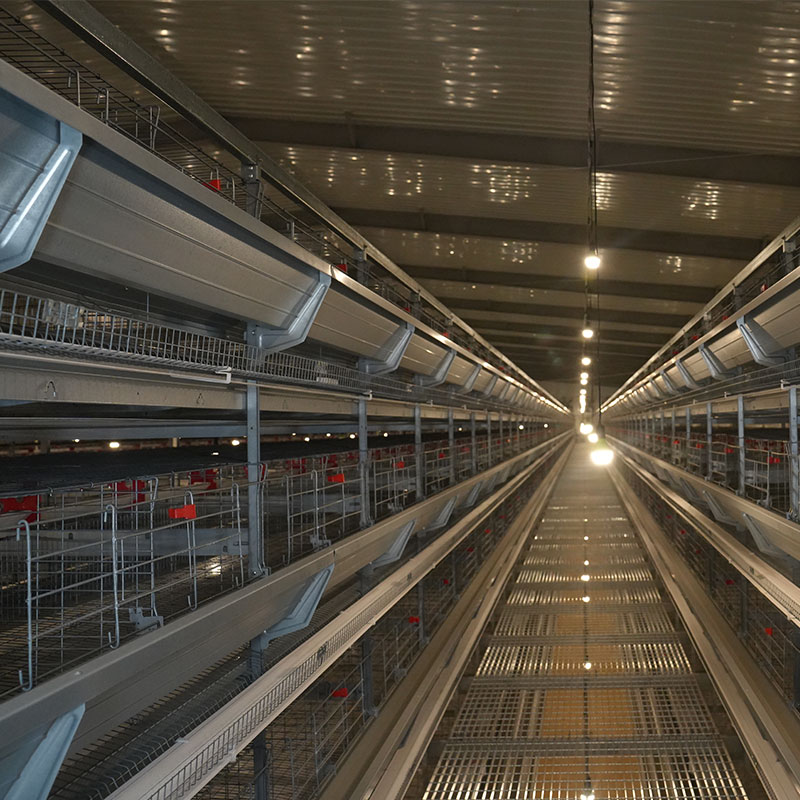
1. Automatic feeding machine can be chosen between gantry and ladder feeding machine. Gantry type feeding machine is a relatively economical and practical machine with simple operation, remote control walking character, easy to manage.
2. Mechanical transmission device running smoothly, low noise, long service life.
3. With the use of automatic control, the feeding system can adjust the amount of material.
4. Feeding with arched structure, high carrying capacity, not easily deformed.
5. Saving man power, saving feed, greatly improving the efficiency of Large-scale farming.
6. The walking speed of gantry feeding machine is 9--12 m/min.




1. Manure removing system included scraper type and conveyor belt type, Which can reduce the labor intensity and labor cost, keep the chicken shed dry and clean.
2. A type chicken cage can use scraper type or conveyor belt type.


3. The scraper type is suitable for A type cages, which can clean two or three rows. For the starters, this type is a good choice. lt can not only save some labor cost, but also save some investment in the whole project. The cleaning speed is 6-10 meters per minute.
4. Conveyor belt type is more suitable for large scale farming. The manure removing belt we use is high quality PP material (polypropylene). The walking speed is 2-4 meters per minute.



High Quality Pellets Made by Mobile Pellet Machine
1. It has professional designed angle of the blade. After the dynamic balance test one by one, the blade can operate smoothly.
2. The air volume is consistent in the whole life of the fan. Bearings has advantage of high strength, low noise, durable and so on.
1. The cooling pads uses high-quality wet curtain paper and adopts space cross-linking technology, which has the advantages of high water absorption, high water resistance, anti-toxicity and long service life.
2. The cooling efficiency is over 80%, without surfactant, natural water absorption, fast diffusion speed and long-lasting effect.
3. The product does not contain phenol and other chemical substances that are easy to cause skin allergies. It is non-toxic and harmless to the human body and chicken when installed and used. It is green, safe, energy-saving, environmentally friendly, economical, and easy to install.
4. The frame aluminum alloy has high strength, good corrosion resistance, durability and beautiful appearance.
5. Use a special filter for the cooling pad at the upper water to ensure clean water quality and support efficient water circulation components.
6. Combined with a negative pressure fan, it can effectively lower the indoor temperature.
The window is made of special selected high-quality engineering plastic, with high strength and long service life, together with superior anti-aging and anti-UV performance.
Function: Ventilation of the chicken house, usually used in the winter.
This system can adjust the wind speed and direction, thus the cold air will not reach chicken directly , which can effectively prevent the phenomenon of cold stress in chicken.
Environmental control system equipment is suitable for large-scale and intensive farming. According to customer requirements, we can provide various types of smart poultry equipment.
1. Our poultry management system is a modular system that manages all aspects of the chicken house, such as climate, temperature, humidity, ammonia, feeding, feed weighing, lighting and ventilation systems, and can monitor the situation of the chicken house in real time through a computer and mobile phone.
2. The management computer is the heart of the poultry farm, allowing you to easily monitor the entire poultry farm.

 WeChat:+8617838608255